Graduate School of Rock
Snobsite.com
Though it is a site meant to promote a book (The Rock Snob*s Dictionary), it stands on its own as as web destination. Meant for Rock Snobs, and the people who have to live with them. Caveat: only if said Rock Snob has a sense of humour about his (yes, it;s usually a guy) obsession, as the site’s authors do. What is a rock snob? If you know who Zimmy is, and which Beatles track it’s cool to like, you’re one of them. For the rest of us, I’ll let the site answer: “Since the dawn of rock, there have been individuals, usually young men of argumentative tendencies, who have lorded their encyclopedic musical knowledge over others.” You get a snob Term of the Day, a large chunk of extracts from the book, an inbuilt blog, and a set of links to other “vaguely snobbish” sites and blogs.
Blog of the week
Tricks of the Trade
Very high up on my things-I-wish-I-had-thought-of list. It started with a blogger who asked his readers for suggestions on tricks of the trade, little professional secrets only people in a specific industry would know. His readers sent him a bunch of suggestions, which he turned into a column on an online publication he wrote for. That column saw huge traffic and citations across the web. So he decided to turn it into a reader-fuelled blog (which in turn, he plans to turn into a book). Down-to-earth suggestions from people in all walks of life, including - random sample, this - cooks, signmakers, parents of toddlers, failed job applicants and alcohol lovers.
Nostalgia isn’t what it used to be
Abandon Ware
For those of our readers old enough to remember MS-DOS games, or even early Windows games, this site is a wonderful blast from the past. An archive of downloadable games that were made by gamemakers now defunct, or made for machines that are now veritable museum pieces. Remember Dave, Digger, Prince of Persia, Hitch Hikers Guide To The Galaxy, Mortal Kombat, Grand Prix Circuit...? Well. they're all here. And free. And customised to be playable on today's lightening fast PCs. Enjoy. (Oh yes. See also: http://www.freeoldies.com/)
Their red caps are Russian
Badmash
A weekly internet comic strip created by three young second gen desis in the USA, Badmash is a favourite with the NRI crowd. Sandeep Sood, Nimesh Patel and Sanjay Shah take digs at the idiosyncrasies of South Asian culture in the US, at US politics, at just about anything in between. Aside from the standard strips, every now and then, they do an animation as well. A personal fave: the hilarious Dishoom, part of their “Green Card Party” campaign for Amitabh Bachchan for President in 2004. And yes, they idolise Mr Bachchan. [Graçias, Annie Zaidi]
Utility site of the week
The Universal Currency Converter ®
The internet is borderless. Currencies, however, are distressingly old-fashioned. This site remedies that. It lets you do instant conversions from any world currency to any other. It covers over 180 currencies in over 250 geographical locations, at live market rates, and also covers precious metals. The service is available to install on your own site in various versions from free, with ads, to a fully customised pay version. In a word, invaluable.
This column explores the wilder, wackier, weirder corners of the world wide web. Mail inthemousetrap@indiatimes.com.
Published in the Times of India, Mumbai edition, 27th May 2005.
The Times of India, Mousetrap
Friday, 27 May 2005


Friday, 20 May 2005
Mousetrap - 3
Eye in the sky
The Gateway to Astronaut Photography of Earth
The government is reportedly waiting for satellite pictures of the city to find out whether mangrove forests around the city have really been cleared. All I can say is that don’t really need to spend all those crores. They just need to check out this NASA site and download some really wonderful high magnification pictures for free. What kind of magnification, you ask? Well, one that has Chowpatty the size of the nail on my little finger is the best I’ve found, so far. Aside from these fabulous city views, you can also view some of their ready-made collections. After all, the site claims to host “the best and most complete online collection of astronaut photographs of the Earth.”
Collaboration rules!
The Wikipedia
There are many fabulous reference sources online. Unfortunately, some of the best require paid subscriptions. Not so the Wikipedia, “the free-content encyclopedia that anyone can edit,” which runs on the wiki platform. What is a wiki? Well, imagine a gigantic blackboard, which anyone who stops by can write on. (And also erase, totally or partially what someone else has written. Before you do that, please make sure you read their instructions!) So you have experts in different areas giving you detailed dissertations on their specialties, with links to other sites and related pages. While the English Wikipedia is the largest, there are also growing wikipedias in other languages, including Hindi, Urdu, Tamil, Kannada and Malayalam. Other Wikimedia projects include Wiktionary, Wikinews, Wikiquote and Wikispecies.
Home-grown
Kamat’s Potpourri
One of the older Indian personal websites, Kamat’s Potpourri is very much a labour of love, produced by Vikas Kamat and his wife, which includes work by his his parents, the scholars the late Dr. K. L. Kamat and Jyotsna Kamat. As the site’s FAQs say, “Among them, they share three Doctorates, Five Masters degrees and seven other University degrees, and Kamat’s Potpourri constitutes over a hundred person-years of work.” So you can expect scholarship and firm opinion for sure! There’s a vast repository of information on Indian history, art, mythology, and much else. One of the amazing things about it is that the older Kamats never used a computer. They would write up their information and mail it to Vikas by post. He would then scan pictures, retype articles, and upload. Like I said, a labour of love.
Blog of the week - Bride in waiting
BridalBeer
An anonymous (though a few bloggers I know have met her) young woman in Calcutta who “was briefly in love.I was in New York for long enough to miss it. Now I am in India, training to be a wife-for-life to a relative stranger (not a stranger who is a relative, we don’t do those).” She writes about the past with the Ex, life as it is now, and the “Would-Bes” she meets, interspersed with the occasional random link and her views on news articles.
Vita Brevis
The Death Clock
Life is precious. You sure you want to be spending all that time staring at your computer screen? Absolutely? Well, go try out this site. Enter your date of birth, weight, sex, attitude(pessimistic sadistic and optimistic are the options available) and whether or not you smoke. Hit enter, and a pop-up gives you your date of death, and a clock begins counting off the seconds you have left. Now, do you still want some more sites to look at? Come to think of it, that’s enough writing for the day. I’m off to get some sunshine.
This column will explore the wilder, wackier, weirder corners of the world wide web. Feedback, suggestions welcome. Mail inthemousetrap@indiatimes.com.
Published in the Times of India, Mumbai edition, 20th May, 2005.
The Times of India, Mousetrap
The Gateway to Astronaut Photography of Earth
The government is reportedly waiting for satellite pictures of the city to find out whether mangrove forests around the city have really been cleared. All I can say is that don’t really need to spend all those crores. They just need to check out this NASA site and download some really wonderful high magnification pictures for free. What kind of magnification, you ask? Well, one that has Chowpatty the size of the nail on my little finger is the best I’ve found, so far. Aside from these fabulous city views, you can also view some of their ready-made collections. After all, the site claims to host “the best and most complete online collection of astronaut photographs of the Earth.”
Collaboration rules!
The Wikipedia
There are many fabulous reference sources online. Unfortunately, some of the best require paid subscriptions. Not so the Wikipedia, “the free-content encyclopedia that anyone can edit,” which runs on the wiki platform. What is a wiki? Well, imagine a gigantic blackboard, which anyone who stops by can write on. (And also erase, totally or partially what someone else has written. Before you do that, please make sure you read their instructions!) So you have experts in different areas giving you detailed dissertations on their specialties, with links to other sites and related pages. While the English Wikipedia is the largest, there are also growing wikipedias in other languages, including Hindi, Urdu, Tamil, Kannada and Malayalam. Other Wikimedia projects include Wiktionary, Wikinews, Wikiquote and Wikispecies.
Home-grown
Kamat’s Potpourri
One of the older Indian personal websites, Kamat’s Potpourri is very much a labour of love, produced by Vikas Kamat and his wife, which includes work by his his parents, the scholars the late Dr. K. L. Kamat and Jyotsna Kamat. As the site’s FAQs say, “Among them, they share three Doctorates, Five Masters degrees and seven other University degrees, and Kamat’s Potpourri constitutes over a hundred person-years of work.” So you can expect scholarship and firm opinion for sure! There’s a vast repository of information on Indian history, art, mythology, and much else. One of the amazing things about it is that the older Kamats never used a computer. They would write up their information and mail it to Vikas by post. He would then scan pictures, retype articles, and upload. Like I said, a labour of love.
Blog of the week - Bride in waiting
BridalBeer
An anonymous (though a few bloggers I know have met her) young woman in Calcutta who “was briefly in love.I was in New York for long enough to miss it. Now I am in India, training to be a wife-for-life to a relative stranger (not a stranger who is a relative, we don’t do those).” She writes about the past with the Ex, life as it is now, and the “Would-Bes” she meets, interspersed with the occasional random link and her views on news articles.
Vita Brevis
The Death Clock
Life is precious. You sure you want to be spending all that time staring at your computer screen? Absolutely? Well, go try out this site. Enter your date of birth, weight, sex, attitude(pessimistic sadistic and optimistic are the options available) and whether or not you smoke. Hit enter, and a pop-up gives you your date of death, and a clock begins counting off the seconds you have left. Now, do you still want some more sites to look at? Come to think of it, that’s enough writing for the day. I’m off to get some sunshine.
This column will explore the wilder, wackier, weirder corners of the world wide web. Feedback, suggestions welcome. Mail inthemousetrap@indiatimes.com.
Published in the Times of India, Mumbai edition, 20th May, 2005.
The Times of India, Mousetrap
Friday, 13 May 2005
Mousetrap - 2
A little potty
Sulabh International Museum of Toilets
Dr Bindeshwar Pathak’s wonderfully quirky little site is the web face of his real life museum in Delhi, and a delightful, um, convenience stop on the information superhighway. Unfortunately, it’s a rather small site. Just a few clumsily designed pages, featuring an essay by the learned doctor, a fawning tribute to him, and an over-before-you-know-it stroll through the virtual museum. But you get to see France’s King Louis XIII’s throne (and I am not being funny here), a portable toilet designed to look like a stack of leather-bound books, commodes with arm- and back-rests… Do use the feedback form and ask the webmaster to expand the site.
Crumbs!
halfbakery
Speaking of toilets, where do you think you’d find Schrodinger's Toilet Seat? Try the halfbakery, where all the ideas that haven’t spent enough time in the oven find a home. It is a “communal database of original, fictitious inventions, edited by its users.” Aside from that toilet seat that is neither up or down, you’ll find a Zen photocopier, Custard-Filled Speed Bumps (speedbreakers to us), glow in the dark beer, and lots, lots more. You can browse without registering, but will have to sign up to contribute or comment. (Hat-tip to Karthi Marshan.)
Myth Universe
Encyclopedia Mythica
An encyclopaedia of mythology, folklore, and religion, it offers as much to the serious student as it does to the casual surfer. Myths sorted by region, folklore in various categories, the site can keep you occupied for hours. It also has an image gallery, a fantastic bestiary that covers all manner of mythical creatures from different cultures, a gallery of legendary heroes, and even a growing set of genealogical tables. The site also has a section on Hindu mythology. And you can subscribe to its RSS feed. No, that’s not what you think. That stands for Really Simple Syndication (among other things), which is a way to read fresh news or blog feeds via a feed reader.
Forward this
Hoaxbusters
I wish I had a buck for each time I get one of those mails telling me that Microsoft, or even Mr Bill himself, would reward me financially for forwarding a certain mail, or the one about the woman who’s husband is suffering from a rare disease (with a Bombay phone number too!), or any number of warnings about worms and virii that reappear every few months. For the frequent offenders I have a particularly nasty mail that one can’t reproduce in a family newspaper. For the people you can’t offend, however, I send them to this site. A pretty comprehensive, categorised listing of hoaxes, chain letters and urban myths, it’s the polite way to tell people they’ve been had.
Blog of the week,
Improbable research
You’ve heard of the Ig Nobels? The prizes that reward scientists who have conducted actual research into phenomena that, well, lets just say the cures for cancer and the common cold don’t feature in the list. Anway, the people behind the awards also send out a newsletter, and recently, like everyone else and his uncle, they started a blog. This one, updated fairly regularly, is a good place to start your daily aimless ramble around the web.
This column will explore the wilder, wackier, weirder corners of the world wide web. Feedback, suggestions welcome. Mail inthemousetrap@indiatimes.com.
Published in the Times of India, Mumbai edition, 13th May, 2005.
The Times of India, Mousetrap
Sulabh International Museum of Toilets
Dr Bindeshwar Pathak’s wonderfully quirky little site is the web face of his real life museum in Delhi, and a delightful, um, convenience stop on the information superhighway. Unfortunately, it’s a rather small site. Just a few clumsily designed pages, featuring an essay by the learned doctor, a fawning tribute to him, and an over-before-you-know-it stroll through the virtual museum. But you get to see France’s King Louis XIII’s throne (and I am not being funny here), a portable toilet designed to look like a stack of leather-bound books, commodes with arm- and back-rests… Do use the feedback form and ask the webmaster to expand the site.
Crumbs!
halfbakery
Speaking of toilets, where do you think you’d find Schrodinger's Toilet Seat? Try the halfbakery, where all the ideas that haven’t spent enough time in the oven find a home. It is a “communal database of original, fictitious inventions, edited by its users.” Aside from that toilet seat that is neither up or down, you’ll find a Zen photocopier, Custard-Filled Speed Bumps (speedbreakers to us), glow in the dark beer, and lots, lots more. You can browse without registering, but will have to sign up to contribute or comment. (Hat-tip to Karthi Marshan.)
Myth Universe
Encyclopedia Mythica
An encyclopaedia of mythology, folklore, and religion, it offers as much to the serious student as it does to the casual surfer. Myths sorted by region, folklore in various categories, the site can keep you occupied for hours. It also has an image gallery, a fantastic bestiary that covers all manner of mythical creatures from different cultures, a gallery of legendary heroes, and even a growing set of genealogical tables. The site also has a section on Hindu mythology. And you can subscribe to its RSS feed. No, that’s not what you think. That stands for Really Simple Syndication (among other things), which is a way to read fresh news or blog feeds via a feed reader.
Forward this
Hoaxbusters
I wish I had a buck for each time I get one of those mails telling me that Microsoft, or even Mr Bill himself, would reward me financially for forwarding a certain mail, or the one about the woman who’s husband is suffering from a rare disease (with a Bombay phone number too!), or any number of warnings about worms and virii that reappear every few months. For the frequent offenders I have a particularly nasty mail that one can’t reproduce in a family newspaper. For the people you can’t offend, however, I send them to this site. A pretty comprehensive, categorised listing of hoaxes, chain letters and urban myths, it’s the polite way to tell people they’ve been had.
Blog of the week,
Improbable research
You’ve heard of the Ig Nobels? The prizes that reward scientists who have conducted actual research into phenomena that, well, lets just say the cures for cancer and the common cold don’t feature in the list. Anway, the people behind the awards also send out a newsletter, and recently, like everyone else and his uncle, they started a blog. This one, updated fairly regularly, is a good place to start your daily aimless ramble around the web.
This column will explore the wilder, wackier, weirder corners of the world wide web. Feedback, suggestions welcome. Mail inthemousetrap@indiatimes.com.
Published in the Times of India, Mumbai edition, 13th May, 2005.
The Times of India, Mousetrap
Friday, 6 May 2005
Mousetrap - 1
What was that word again?
Word Spy
You know all those I’m-so-cool words that suddenly come into vogue with the with-it corpo crowd? That get bandied about by the young B-school grads with the power ties? This site is a good place to figure out what the heck they’re saying. Seriously, though (and before my MBA friends put a fatwa out on me), the site is a fascinating repository of what’s new and happening. It calls what it does “lexpionage,” or the sleuthing of new words and phrases. And the words it chooses aren’t the made-up variety of doubtful provenance that descend into your inbox with monotonous regularity. Word Spy includes detailed citations of each entry.
Click to find
Bartleby.com
This is what the net was supposed to be: free information across borders.
This site is one of many (we’ll cover some more in future columns) that give you online versions of books, absolutely free. Bartleby is best known for the invaluable set of reference books it offers. (A small sampler: Roget's Thesaurus, Fowler's King's English, Strunk and White’s Elements of Style, World's Orations, Oxford Shakespeare, Gray’s Anatomy, World Factbook, Oxford English Verse, the Bhagavad Gita, the King James Bible, and much more.) But it also has sections on non-fiction, fiction, and poetry.
Worth a virtual bookmark, hmm?
Creature Feature
Cryptozoology
Cryptozoologists study animals that are presumed to exist, ranging from the mythological to those which are presumed extinct. In this field of, um, science, these creatures are called cryptids, and include everything from the Yeti and the Loch Ness monster to the thylacine (or Tasmanian Tiger, sightings of which have been reported recently) and the ivory-billed woodpecker, recently spotted in the USA.
This site, run, not by professionals or organisations, but by amateur enthusiasts, lists many cryptids, has a bunch of interesting links and news, articles, pictures, a discussion forum, and lots more. Parts of the site are accessible only to members, but joining is free.
Sea Major
Jazz Goa
If you’re headed for India’s only truly tourist-friendly state, and you want to make sure you hear music other than techno, trance, or whatever the beach shack guys are playing these days, check out this site.
The aesthetics range from dull to chaotic (too many add-on services have been jammed in without customising the look), and the home page sounds like it’s been put together by the marketing team in a consumer products MNC.
But never mind all that. What counts is that it lists venues and musicians, has a few MP3 files by Goan jazz artists to download (and one solitary video), and best of all, a gig guide that lists coming performances.
From the badlands
The Jesustan Diaries
The tongue-in-cheek travels and travails of a desi in the Land of the Free, which he calls Jesustan. The anonymous blogger, who signs himself ‘PS’, adopts the condescending style of countless white travellers in heathen lands, taking quiet little digs at all manner of Americana. But he’s even-handed, is PS. He just as frequently turns his scathing wit on desis in the US, and on the home country too. Unlike many bloggers, he doesn’t post daily. But he does promise one post each weekend, and he does long posts, so, I guess, it’s worth the wait.
This column will explore the wilder, wackier, weirder corners of the world wide web. Feedback, suggestions welcome. Mail inthemousetrap@indiatimes.com.
The first edition of a column in the Times of India's Bombay edition. Published 6th May, 2005.
The Times of India, Mousetrap
Word Spy
You know all those I’m-so-cool words that suddenly come into vogue with the with-it corpo crowd? That get bandied about by the young B-school grads with the power ties? This site is a good place to figure out what the heck they’re saying. Seriously, though (and before my MBA friends put a fatwa out on me), the site is a fascinating repository of what’s new and happening. It calls what it does “lexpionage,” or the sleuthing of new words and phrases. And the words it chooses aren’t the made-up variety of doubtful provenance that descend into your inbox with monotonous regularity. Word Spy includes detailed citations of each entry.
Click to find
Bartleby.com
This is what the net was supposed to be: free information across borders.
This site is one of many (we’ll cover some more in future columns) that give you online versions of books, absolutely free. Bartleby is best known for the invaluable set of reference books it offers. (A small sampler: Roget's Thesaurus, Fowler's King's English, Strunk and White’s Elements of Style, World's Orations, Oxford Shakespeare, Gray’s Anatomy, World Factbook, Oxford English Verse, the Bhagavad Gita, the King James Bible, and much more.) But it also has sections on non-fiction, fiction, and poetry.
Worth a virtual bookmark, hmm?
Creature Feature
Cryptozoology
Cryptozoologists study animals that are presumed to exist, ranging from the mythological to those which are presumed extinct. In this field of, um, science, these creatures are called cryptids, and include everything from the Yeti and the Loch Ness monster to the thylacine (or Tasmanian Tiger, sightings of which have been reported recently) and the ivory-billed woodpecker, recently spotted in the USA.
This site, run, not by professionals or organisations, but by amateur enthusiasts, lists many cryptids, has a bunch of interesting links and news, articles, pictures, a discussion forum, and lots more. Parts of the site are accessible only to members, but joining is free.
Sea Major
Jazz Goa
If you’re headed for India’s only truly tourist-friendly state, and you want to make sure you hear music other than techno, trance, or whatever the beach shack guys are playing these days, check out this site.
The aesthetics range from dull to chaotic (too many add-on services have been jammed in without customising the look), and the home page sounds like it’s been put together by the marketing team in a consumer products MNC.
But never mind all that. What counts is that it lists venues and musicians, has a few MP3 files by Goan jazz artists to download (and one solitary video), and best of all, a gig guide that lists coming performances.
From the badlands
The Jesustan Diaries
The tongue-in-cheek travels and travails of a desi in the Land of the Free, which he calls Jesustan. The anonymous blogger, who signs himself ‘PS’, adopts the condescending style of countless white travellers in heathen lands, taking quiet little digs at all manner of Americana. But he’s even-handed, is PS. He just as frequently turns his scathing wit on desis in the US, and on the home country too. Unlike many bloggers, he doesn’t post daily. But he does promise one post each weekend, and he does long posts, so, I guess, it’s worth the wait.
This column will explore the wilder, wackier, weirder corners of the world wide web. Feedback, suggestions welcome. Mail inthemousetrap@indiatimes.com.
The first edition of a column in the Times of India's Bombay edition. Published 6th May, 2005.
The Times of India, Mousetrap
Sunday, 1 May 2005
Where books go after they’re down-sized.
New and Secondhand Bookshop
A hundred years ago, Jamalbhai Ratansi, who ran a business in the raddi trade, decided to start a shop on the Kalbadevi Road, near what is now the Metro junction. You see, along with the old newspapers, he also frequently bought bundles of discarded books by weight. So he decided to start selling them piecemeal, at prices way below the original cost, but still a tidy mark-up from what he paid for them.
Thus was born New And Secondhand Bookshop, Bombay institution and landmark. In 1917, it moved to its current location, just across the street from the now-demolished building that was its previous home.
Jamalbhai has since departed for the Reading Room in the Sky, but N&S is still very much here, run by Sultan Vishram, Jamalbhai’s grandson and the current proprietor.
Over the years, N&S has had a long string of famous customers. Sultanbhai pulls out a fat file of press clippings, and tells me that B R Ambedkar, R K Narayan, Manohar Malgaonkar, Mulk Raj Anand, P L Deshpande and Osho Rajneesh all bought books from the shop.
Ambedkar, he says, never came in, always staying in his car outside, while someone else bought his books. Rajneesh (then plain Acharya) would come in at least once a week, and spend an hour browsing, before bargaining vigorously over the books he wanted, “He would say he was a sadhu, and the books should be given free. But my uncle would tell him, ‘Aap sadhu hain, hum to sansari hain na?’”
Which is not to say, he continues, after the chuckles have subsided, that commerce ever dominated love of books. Jamalbhai would frequently told customers who couldn’t afford books, “Go ahead, pay later. Learn, learn!” And his son, Sultanbhai’s uncle, loved to say “Saraswati and Lakshmi can’t sit in the same place.”
The “New” in the shop’s name is technically accurate – they do stock new titles on certain subjects like interior decoration and art – but the tight margins in that trade make it an unattractive business proposition, so they make up less than 10% of inventory. It’s the musty smell of old books that dominates. The very rare finds are stored under lock and key. But out there in the open is the gamut from a 1955 Encyclopaedia Britannica set and Shaw’s Complete Prefaces to elderly pulp paperbacks and mildly bruised coffee-table books. (My personal finds dating back from impoverished college years include a treasured 25th Anniversary Peanuts Collection, a stack of cloth-bound Wodehouses, and much crime and science fiction.)
Sultanbhai only began managing the shop actively in the last few months, after the retirement of his manager, Chandrakant Mankame. Mr Mankame had served the shop for sixty years, starting at age 11, as the founder’s gofer. Jamalbhai had sent him to night school, where he learned English. As he grew up, he was given more and more responsibility, till he became manager.
He has a mind like a computer, Sultanbhai tells me. In sixty years, he had bought almost every book in the shelves, and could remember exactly which dusty pile in which crammed shelf in which narrow row housed a certain book. Without this human database (in January, after seeing the shop into its centenary year, Mankame finally retired), Sultanbhai has begun to reorganise the shop so that less elephantine memories can cope, rearranging sections, making out an inventory, and perhaps, if he can bring himself to go entirely modern, a computerised database.
“There’s no other proper shop like ours in Bombay,” says Sultanbhai. And, unfortunately, there soon might be none.
“The book trade on the whole is suffering,” he says, “There is TV, computers… People don’t read that much anymore. And all these books, until we get a customer, they’re just someone’s discarded junk. [The reorganisation and renovation] is my last effort. If business does not improve, I will have to close down and sell.”
Isn’t there a market for rare books, I ask him. He shakes his head. “Once, yes, we’d find some rare books in our purchases. Now,” wry smile, “people are smart. They know what’s rare.”
Yes, I murmur to myself on the way out. But then New And Secondhand is rare too. And I hope to hell enough customers keep trooping in to take it into its second century, that Lakshmi can give Saraswati the teensiest helping hand.
New And Secondhand Bookshop, 526, Kalbadevi Road, Mumbai 400002. Ph: +91 22 22013314 Fax (care of): +91 22 22072024.
Published in the Outlook Traveller, May 2005 edition, in the column Favourite Things, under the title "Old Curiosity Shop" or some such.
Tags: Outlook Traveller, Favourite Things
Travelling the world (wide web)
Imagine there’s no countries,
It isn’t hard to do
The web, brothers and sisters, has no boundaries. We’re one big, happy family, connected by Sir Tim Berners-Lee’s invention.
The world is literally at one’s fingertips, and for many a geek, that’s nirvana.
But, thankfully for the tourism industry, vast multitudes move their atoms and disposable incomes around the world, instead of pulling bytes to their desktop.
Today’s enlightened travellers make their own itineraries, rather than doing the despised package holiday routine. So guidebooks still figure largely in holiday plans, and travel magazines aren’t just for the armchair traveller.
But the net is now ubiquitous enough for it to have an increasingly bigger influence on travel choices. There are sites run by tourism boards and the like. And every resort and hotel worth its IT budget has a website of sorts too. For you, that’s plenty of places where you can check rates, preview local attractions, research taboos, check out possible side-trips and so on. But these are commercial sites, which, by definition, paint a seductive picture of what they’re promoting (and some can be rather economical with the truth). And there’s so damn many of them.
Where, then, does the canny netizen go to get an unbiased picture of the place s/he wants to visit?
There are sites (like the one run by this mag) with articles by specialist writers and photographers, of course. God bless ’em all, and may they prosper and continue to pay me (preferably more than they do already) to travel and write for them.
But there’s another, more democratic phenomenon which might interest you: the travel community site.
Here, ordinary people, people like you (not me, I’m a specialist, m’dear, don’t do this at home, etc.), exchange info, tips, raves and rants about the places they’ve visited or are about to, make connections with potential travel companions, show pictures, and much more.
These sites usually support themselves with ads, but are not beholden to their advertisers, since the ads are usually served by automated processes. So, while you most certainly will see bias on an individual level, you can rely on them not having a commercial axe to grind.
So, when you next wanna wander, whisper softly into you search engine’s ear, “travel community.” Happy trails.
Imagine all the people
Sharing all the world.
Siteseeing
virtualtourist, aside from the standard members’ articles and pictures, features a nifty do-it-yourself guidebook. As you wander the site, you can flag stuff to be included in your personal folders, then assemble it into a PDF which you can print or save.
world66 offers the basics, plus PDF guides, and stuff you can download to smart phones, GPS systems and other handheld devices.
bootsnall is geared towards the independent traveller, the backpacker, go with the flow type.
http://thorntree.lonelyplanet.com is the forum run by the backpacker world’s bible. ’Nuf said?
indiaresortssurvey, as the name suggests, covers Indian resorts. It lets you rate them, and check out other people’s ratings, and adds on goodies for regular contributors.
hermail.net is an international directory of women travellers.
flyertalk is dedicated to frequent flyer miles. As the site says, “all miles, all the time”
couchsurfing, hospitalityclub.org and globalfreeloaders all (in slightly different ways) let you link up with people at the other end of your return ticket to get yourself accommodation that’s free, cheap, or bartered on a reciprocal basis.
In addition, many online communities have channels or sub-sections devoted to travel. A random example anothersubcontinent.com, a community of (mainly) expat desis, who have, among their other fora, one dedicated to travel: www.anothersubcontinent.com/forums/index.php?&showforum=23
Published in Outlook Traveller, May edition.
Tags: Outlook Traveller
It isn’t hard to do
The web, brothers and sisters, has no boundaries. We’re one big, happy family, connected by Sir Tim Berners-Lee’s invention.
The world is literally at one’s fingertips, and for many a geek, that’s nirvana.
But, thankfully for the tourism industry, vast multitudes move their atoms and disposable incomes around the world, instead of pulling bytes to their desktop.
Today’s enlightened travellers make their own itineraries, rather than doing the despised package holiday routine. So guidebooks still figure largely in holiday plans, and travel magazines aren’t just for the armchair traveller.
But the net is now ubiquitous enough for it to have an increasingly bigger influence on travel choices. There are sites run by tourism boards and the like. And every resort and hotel worth its IT budget has a website of sorts too. For you, that’s plenty of places where you can check rates, preview local attractions, research taboos, check out possible side-trips and so on. But these are commercial sites, which, by definition, paint a seductive picture of what they’re promoting (and some can be rather economical with the truth). And there’s so damn many of them.
Where, then, does the canny netizen go to get an unbiased picture of the place s/he wants to visit?
There are sites (like the one run by this mag) with articles by specialist writers and photographers, of course. God bless ’em all, and may they prosper and continue to pay me (preferably more than they do already) to travel and write for them.
But there’s another, more democratic phenomenon which might interest you: the travel community site.
Here, ordinary people, people like you (not me, I’m a specialist, m’dear, don’t do this at home, etc.), exchange info, tips, raves and rants about the places they’ve visited or are about to, make connections with potential travel companions, show pictures, and much more.
These sites usually support themselves with ads, but are not beholden to their advertisers, since the ads are usually served by automated processes. So, while you most certainly will see bias on an individual level, you can rely on them not having a commercial axe to grind.
So, when you next wanna wander, whisper softly into you search engine’s ear, “travel community.” Happy trails.
Imagine all the people
Sharing all the world.
Siteseeing
virtualtourist, aside from the standard members’ articles and pictures, features a nifty do-it-yourself guidebook. As you wander the site, you can flag stuff to be included in your personal folders, then assemble it into a PDF which you can print or save.
world66 offers the basics, plus PDF guides, and stuff you can download to smart phones, GPS systems and other handheld devices.
bootsnall is geared towards the independent traveller, the backpacker, go with the flow type.
http://thorntree.lonelyplanet.com is the forum run by the backpacker world’s bible. ’Nuf said?
indiaresortssurvey, as the name suggests, covers Indian resorts. It lets you rate them, and check out other people’s ratings, and adds on goodies for regular contributors.
hermail.net is an international directory of women travellers.
flyertalk is dedicated to frequent flyer miles. As the site says, “all miles, all the time”
couchsurfing, hospitalityclub.org and globalfreeloaders all (in slightly different ways) let you link up with people at the other end of your return ticket to get yourself accommodation that’s free, cheap, or bartered on a reciprocal basis.
In addition, many online communities have channels or sub-sections devoted to travel. A random example anothersubcontinent.com, a community of (mainly) expat desis, who have, among their other fora, one dedicated to travel: www.anothersubcontinent.com/forums/index.php?&showforum=23
Published in Outlook Traveller, May edition.
Tags: Outlook Traveller
Friday, 22 April 2005
So you want to start a (clears throat) blog
It’s been the buzz all year, this strange word that sounds, as someone I know said recently, like something stuck in one’s mucus membranes.
Never mind them technophobes. The facts are that “blog” was the most looked-up word in an online dictionary last year, that bloggers were Time’s People of the Year, that world media has started taking notice, that corporate bodies began thinking of them as marketing tools, and that everyone and their second cousins want to give you their blog URLs.
So what is a blog anyway? It’s a hybrid word, short for “web log,” and at its most basic, it is a website with dated entries, usually in reverse chronological order.
From there on, they’re what you want them to be: guides to interesting web pages; diaries; confessionals; showcases; conversations; soap boxes, pulpits; dashing white chargers to gallop to crusades on; whatever rocks your boat.
Conveniently ignoring, for the purpose of this column, the now rapidly-expanding tribe of blogs that focus on visual content, I’ll risk another sweeping generalisation.
A blog is essentially about words. And your readership – indeed, whether you get read at all, aside from you, yourself, and your alter ego – depends on a combination of your subject matter and how good you are at stringing words together.
So, given that, should writers – serious writers, professional writers – blog?
I’d give you a guarded “yes.” For several reasons.
If you take your blog seriously, it’s daily writing calisthenics. There’s only one way to become a better writer, and that’s by writing. And feeling the obligation to blog means that you park your butt in front of a computer and write. And since someone might be reading you, you better write good, you know?
Blogs are also a good way to try out new ideas, workshop your writing, and to get feedback. Feedback is not guaranteed, of course, but there are ways to get yourself noticed and commented on. That, however, is a subject that could take up an entire column’s worth of space. Besides, it’s pretty easy to go looking for how-to lessons. The Lord Google knows that the web is crawling with blogging gurus.
Being creatures of the web, blogs, by definition, are not limited to geographic boundaries. The world is very much your oyster. Not just with readership. Advances in blogging applications make it easy to collaborate across the miles, or to band together with like-minded writers from around the world, to put together a whole greater than the sum of its parts. (Personally, I have found this a very effective method, and I’ve midwifed collaborations that have met with moderate to phenomenal success. Though not strictly an example of a writers’ collaboration, the tsunamihelp set of blogs only became a world-wide clearing house for information on the disaster because they were a group of dedicated people acting in concert.)
Then, of course, there’s the recognition bit, very important for the up-and-coming writer trying to make a mark. Here, as with feedback, just being good is no guarantee that you will get any. But again, there are ways to break through, though you’d better be consistently good to keep your audience.
Oh yes, blogs can actually make you some money. Not a fortune, I hasten to add, but an ad programme can bring in a few bucks. Provided your content is compelling enough to bring in the readers.
Other business models have been floated. Like using your blog as an advertisement for your other writing. Or actually selling your other writing online, through downloadable documents, for example.
And of course, there’s the Holy Grail. The book contract. Publishers are always on the lookout for the next phenom, and many popular bloggers have parlayed their online success into fat publishing contracts.
There is, however, another side to all these arguments.
Blogs can take up an awful lot of your time and energy. It can certainly get in the way if you need to do a lot of Real Writing. The writing that pays the bills. That editors and publishers will write cheques for.
William Gibson, one of the few Big Name authors who runs a blog (at least one of the few who does it under his own name) has an opinion you might want to consider. Just before his blog went into a long hiatus, he posted this entry.
“...the thing I’ve most enjoyed about [blogging] is how it never fails to underline the fact that if I’m doing this I’m definitely not writing a novel – that is, if I’m still blogging, I’m definitely still on vacation. I’ve always known, somehow, that it would get in the way of writing fiction, and that I wouldn’t want to be trying to do both at once. The image that comes most readily to mind is that of a kettle failing to boil because the lid’s been left off.”
So, should you blog? I’d say give it a try. After a while, you’ll figure out if you’re getting – or on the way to getting – pleasure, fame or money out of it.
If not, hawk deeply, and eject it from your system.

The writer blogs at http://zigzackly.blogspot.com/, and has founded, runs or contributes to several collaborations, which you can find links to from his blog. He founded the collaborative South-East Asia Earthquake and Tsunami blog, which created blogging history and gave him 15 seconds of fame in January ’05.
—-box--
Authors who blog.
Internationally, there’s Gibson, who blogs sporadically now, at http://www.williamgibsonbooks.com/blog/archive.asp, and Neil Gaiman at http://www.neilgaiman.com/journal/journal.asp.
In India, Manjula Padmanabhan, author and illustrator (Kleptomania, Mouse Invaders, Mouse Attack, Hot Death,Cold Soup, Getting There, Harvest, Hidden Fires) blogs at http://marginalien.blogspot.com. Samit Basu (The Simoqin Prophecies) writes http://samitbasu.blogspot.com and http://pututhecat.blogspot.com.
Many of the new breed of Indian journalists are blogging too, about books, politics, opinion, or just for fun. A quick sampler: http://akhondofswat.blogspot.com/, http://dcubed.blogspot.com/, http://jaiarjun.blogspot.com/, http://kitabkhana.blogspot.com/, http://knownturf.blogspot.com/.
Errata:
I screwed up in the People of the Year thing, as Amit pointed out to me. Darn. My only excuse is that for the last few days of December and most of January, I read very little that wasn't Tsunami-related.
And in the print edition of this piece, I managed to get Samit Basu's URL wrong (I put in ducksrule.blogspot.com). I did attempt to make amends by tying to set up a blog with that URL that would have a redirect link to his blog, but sadly, it was taken.
Tags: Man's World
Never mind them technophobes. The facts are that “blog” was the most looked-up word in an online dictionary last year, that bloggers were Time’s People of the Year, that world media has started taking notice, that corporate bodies began thinking of them as marketing tools, and that everyone and their second cousins want to give you their blog URLs.
So what is a blog anyway? It’s a hybrid word, short for “web log,” and at its most basic, it is a website with dated entries, usually in reverse chronological order.
From there on, they’re what you want them to be: guides to interesting web pages; diaries; confessionals; showcases; conversations; soap boxes, pulpits; dashing white chargers to gallop to crusades on; whatever rocks your boat.
Conveniently ignoring, for the purpose of this column, the now rapidly-expanding tribe of blogs that focus on visual content, I’ll risk another sweeping generalisation.
A blog is essentially about words. And your readership – indeed, whether you get read at all, aside from you, yourself, and your alter ego – depends on a combination of your subject matter and how good you are at stringing words together.
So, given that, should writers – serious writers, professional writers – blog?
I’d give you a guarded “yes.” For several reasons.
If you take your blog seriously, it’s daily writing calisthenics. There’s only one way to become a better writer, and that’s by writing. And feeling the obligation to blog means that you park your butt in front of a computer and write. And since someone might be reading you, you better write good, you know?
Blogs are also a good way to try out new ideas, workshop your writing, and to get feedback. Feedback is not guaranteed, of course, but there are ways to get yourself noticed and commented on. That, however, is a subject that could take up an entire column’s worth of space. Besides, it’s pretty easy to go looking for how-to lessons. The Lord Google knows that the web is crawling with blogging gurus.
Being creatures of the web, blogs, by definition, are not limited to geographic boundaries. The world is very much your oyster. Not just with readership. Advances in blogging applications make it easy to collaborate across the miles, or to band together with like-minded writers from around the world, to put together a whole greater than the sum of its parts. (Personally, I have found this a very effective method, and I’ve midwifed collaborations that have met with moderate to phenomenal success. Though not strictly an example of a writers’ collaboration, the tsunamihelp set of blogs only became a world-wide clearing house for information on the disaster because they were a group of dedicated people acting in concert.)
Then, of course, there’s the recognition bit, very important for the up-and-coming writer trying to make a mark. Here, as with feedback, just being good is no guarantee that you will get any. But again, there are ways to break through, though you’d better be consistently good to keep your audience.
Oh yes, blogs can actually make you some money. Not a fortune, I hasten to add, but an ad programme can bring in a few bucks. Provided your content is compelling enough to bring in the readers.
Other business models have been floated. Like using your blog as an advertisement for your other writing. Or actually selling your other writing online, through downloadable documents, for example.
And of course, there’s the Holy Grail. The book contract. Publishers are always on the lookout for the next phenom, and many popular bloggers have parlayed their online success into fat publishing contracts.
There is, however, another side to all these arguments.
Blogs can take up an awful lot of your time and energy. It can certainly get in the way if you need to do a lot of Real Writing. The writing that pays the bills. That editors and publishers will write cheques for.
William Gibson, one of the few Big Name authors who runs a blog (at least one of the few who does it under his own name) has an opinion you might want to consider. Just before his blog went into a long hiatus, he posted this entry.
“...the thing I’ve most enjoyed about [blogging] is how it never fails to underline the fact that if I’m doing this I’m definitely not writing a novel – that is, if I’m still blogging, I’m definitely still on vacation. I’ve always known, somehow, that it would get in the way of writing fiction, and that I wouldn’t want to be trying to do both at once. The image that comes most readily to mind is that of a kettle failing to boil because the lid’s been left off.”
So, should you blog? I’d say give it a try. After a while, you’ll figure out if you’re getting – or on the way to getting – pleasure, fame or money out of it.
If not, hawk deeply, and eject it from your system.
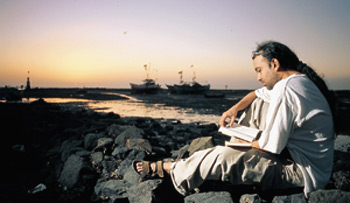
The writer blogs at http://zigzackly.blogspot.com/, and has founded, runs or contributes to several collaborations, which you can find links to from his blog. He founded the collaborative South-East Asia Earthquake and Tsunami blog, which created blogging history and gave him 15 seconds of fame in January ’05.
Published in an edited version in Man's World, April Edition, in a section called Writer's Lives.
—-box--
Authors who blog.
Internationally, there’s Gibson, who blogs sporadically now, at http://www.williamgibsonbooks.com/blog/archive.asp, and Neil Gaiman at http://www.neilgaiman.com/journal/journal.asp.
In India, Manjula Padmanabhan, author and illustrator (Kleptomania, Mouse Invaders, Mouse Attack, Hot Death,Cold Soup, Getting There, Harvest, Hidden Fires) blogs at http://marginalien.blogspot.com. Samit Basu (The Simoqin Prophecies) writes http://samitbasu.blogspot.com and http://pututhecat.blogspot.com.
Many of the new breed of Indian journalists are blogging too, about books, politics, opinion, or just for fun. A quick sampler: http://akhondofswat.blogspot.com/, http://dcubed.blogspot.com/, http://jaiarjun.blogspot.com/, http://kitabkhana.blogspot.com/, http://knownturf.blogspot.com/.
Errata:
I screwed up in the People of the Year thing, as Amit pointed out to me. Darn. My only excuse is that for the last few days of December and most of January, I read very little that wasn't Tsunami-related.
And in the print edition of this piece, I managed to get Samit Basu's URL wrong (I put in ducksrule.blogspot.com). I did attempt to make amends by tying to set up a blog with that URL that would have a redirect link to his blog, but sadly, it was taken.
Tags: Man's World
Saturday, 1 January 2005
Lazing Saddles
Peter Griffin rises at noon to amble along the holiday coast on rented wheels
It feels strange to be flying into Goa. Barring the occasional office junket in the distant past, previous trips in have been via rail or road. You have time to get your system acclimatised that way. Now, there’s still city smog in my lungs, airline food that has sunk like a lead ball to the bottom of my stomach, sore wrists from the manic burst of work that I had stayed up all night to finish so I could make this trip.
When you go to Goa by more sedate forms of transport, you detox by the time you get there, pleasantly travel-weary, and you’re ready to make the acquaintance of a tall, dewy glass. And, with Goa’s enlightened policy towards excise, those tall dewy glasses are available here at a significantly lower price than in other parts of the country.
We deplane, and we still haven’t made up our minds where we’re going first: nearby Vasco, since we’re going to be flying out; Margao, or the North. We stop off at the tourism department’s stall, and pick up a map. The lady behind the counter looks at my scruffy attire and travel-stained haversack, and tells us we need to sprint if we want to catch the Margao bus. Our minds made up, we scramble.
Not a bus in sight. Instead we’re accosted by taxi drivers. Vasco isn’t high on their priority lists. Margao, Panjim or Mapusa is more to their liking. We decide to head South.
Atul, wordly-wise and combative, does the haggling and secures us a cab.
Taxis are supposed to run to a meter - eight bucks a kilometre, luggage extra - but that rarely happens. Aside from taxis (and of course, the public busses), Goa has another unique form of public transport, called “pilots.” A pilot is a bloke who rides a motorbike taxi, distinguished from private bikes by a yellow front mudguard. His pillion seat is for hire, so they’re handy when you’re travelling solo. They usually ply within cities and their outskirts, and its not unusual to see an impeccably turned out elderly matron clutching a shopping bag, perched demurely behind a scruffy young man she might hesitate to invite to her home for tea. The pilots that hang around near railway stations and bus stands will also do the longer runs. As with the taxis, a healthy spell of bargaining before-hand is the only way to go.
En route, we change plans, abandoning Palolem in favour of the much nearer Colva. Our driver takes us right into a hotel portico, near the beach. I ask him how much of a cut he gets for bringing us here. Only fifty bucks, boss, he says with a disarmingly sheepish grin.We inspect a few rooms, and check in.
There’s accommodation to suit every budget. From the five star resorts and boutique hotels, to shacks that will set you back less per day than you’d pay for a beer at the fancier restaurants. For a two-bed non-AC room with attached loo, you’d pay from Rs 150 (off-season, in a less crowded beach area) to a few thousand (peak season, popular beach). Beach shacks can be had for even less.
We adjourn to a beach front restaurant and sip beer. Atul, a restless bloke if there ever was one, wanders off, festooned with cameras, enormous lens dangling from his belt, to see what the beach action is like. I demolish a pancake, finish his beer, and order myself another, and amuse myself by SMSing friends hard at work in the city. Life is good.
Your cellphone will roam comfortably around most of Goa, barring a few stretches or remote hilly road in the South. Keep your settings at Automatic Select, though, because some networks offer better coverage than others in some parts of the state.
Atul comes back to tell me of a restaurant he just recognised from a previous trip shooting for an Outlook Traveller guide book. The place boasts a famous resident masseur, a bit of a local landmark, he says, which gets my attention. My back is stiff from the previous night, and I’m a sucker for massages anyway. Nyet, says A. He wants to shoot the man kneading attractive female body. If I liked, though, I could come along and talk to him. We wander off to Boomerang, as the place is called, a few minutes down the beach. Peter Coutinho, the owner, is awake now, and gives his permission to shoot on the premises, and even charms one of his guests into being our model. While Guptaji, the elderly masseur, and gets to work, and Atul does likewise, i doze off in an armchair. Atul’s lens satisfied, we thank the lady who posed for us, and settle down to chat with Guptaji. He’s from Varanasi, but spends ten months of the year in Boomerang, doing massages at Rs 150 for 30 minutes. He’s been doing this for twelve years, since his wife died. He’s entirely self-taught, he tells us, or rather, he says that his gifts are god-given, not learned formally. He also sings old Hindi film songs. i decide to invest a part of our budget into a one hour head and back massage. The man lives up to his reputation - when i rise from the sunbed, the stiffness in my back has eased. Atul takes his turn while i go back to our room to shower off the oil. When i return, my hyperactive photographer is asleep, and Guptaji is pleased at this tribute to his skills.
We stay up pretty late, and next morning, we both oversleep drastcally - waking up past noon. After breakfast, we go bike hunting, and then head straight for the South, missing Benaulim thanks to my bad navigation. We also manage to unintentionally bypass Varca, Cavelossim and Mobor as well.
Mobor, we have heard, is a firang trap. Some of the beach shack restaurants there, apparently, are run by the five stars that line the beach, and the right hand column reflects that. Not to be outdone, other local-run shacks have sprung up around there too, with prices not quite five-star, but definitely more expensive than the ones on other beaches.
We cross the high ground that separates Salcete from Quepem, detouring slightly to take in the view from a chapel on a hill somewhere between Verlim and Betul. While Atul clambers around, i drink in the maze of creek, backwater, river mouth, the sea of coconut fronds swaying far below us, and the enormous mirror smooth expanse of the ocean, silver turning to burnished bronze as the sun sinks lower. i SMS a friend again, to be get an irritable reply. She’s locked into an edit meeting, and her ideas have just been bombed. i start to type a contrite reply, when Atul reappears and demands that we move. He wants to get the sunset at Palolem. We zoom off, reluctantly ignoring the road down to Cabo de Rama, resist Agonda’s blandishments, but still screech into Palolem after the sun has disappeared into a hazy horizon. The sky is still streaked red, but the entire stretch of beach is already lit up with fairylights, candles, even the odd halogen. Different strains of music from each eating place competes with the wave sounds. Palolem, once a quiet backpacker’s paradise, has been discovered. While its still not as chaotic as, say, Baga, the market now extends all the way to the beach entrance, and even spills onto the sands, once the preserve of the shack restaurants. Atul makes what he can of the remaining light, and i doze off waiting for my squid butter garlic to appear.
While most of the beach villages feature a wide selection of restaurants on their main streets, it’s much better eating at the beach shacks. The cuisine is varied - Goan, Punjabi, Mughlai, Chinese, a fair amount of continental dishes, and, increasingly, Israeli menus as well. You can count on the seafood being fresh. If you’re vegetarian, you won’t have much variety to choose from. An average meal can cost you upwards of Rs 100 (add on a bit more in a more popular beach), minus the drinks. Oh yes, good coffee is hard to find. Most restaurants only serve instant swill.
By the time we head back north, it is much later than we intended. We decide to head straight for the highway rather than do the backroads. This stretch of NH17 isn’t lit, so we have to cope with headlights on high beam hitting us full in the face every few minutes. We’re both in shorts and T-shirts, and the ride is a cold one. In addition to the windchill, we also have to deal with being buffeted by the slipstream of every passing bus and truck. Atul, the experienced biker, leads. i focus on the wedge of light his headlight carves into the night, and we cut our way through the darkness.
We head to Boomerang, where Peter has invited us to join in on a party. By the time we crawl home, it’s close to dawn. Naturally, we oversleep again.We check out way past noon, and after breakfast, set off for North Goa. Atul wants to see the Wednesday flea market at Anjuna. I’m not as enthusiastic - i usually avoid the “happening” North for the peace of the South. He has the faster bike, so he zooms on ahead to get to Anjuna before sundown. I amble along at a more leisurely 50 kmph, miss Panjim without realising it, and wind up approaching Baga from an unfamiliar direction. i manage to circle Anjuna several times without finding Atul. But i do find a restaurant with a great view of a rocky bay, and i find a good seat to watch the moon on the water. A group of young carollers sing to the diners at the next restaurant. So, in honour of the festive season, i order three Kings beers and wait for Atul to find me. Unable to find a place to stay at Anjuna, we scoot up to Vagator. Where every hotel seems to be fast asleep. We finally manage to get ourselves a room after midnight, and promptly race off to get ourselves some dinner in the last restaurant still serving.
Next day, we decide to skip the dubious pleasures of the Calangute-Baga-Anjuna-Vagator stretch and head further north. Our first stop is Morjim. A lovely stretch of beach, near the mouth of a river, its waters are so clear that i could see my toes in the sand in neck deep water. Almost the only Indians here are the guys who run the shacks. Which feature names like Planet Hollywood and Hard Rock Cafe. A group of Indian men, paddling around in their underwear and leering at the pink flesh on display, are the only blot on the landscape.
Next stop, Arambol. A friend has raved to me about the deserted beach, and the freshwater lake there, a few metres away from the sea. It’s been a long time since he was here, evidently. Arambol is packed. A narrow lane lead up to the sand, and the beach has the normal complement of shack restaurants. We trudge around the side of a hill to get to the lake. The entire path is lined with stalls selling all manner of touristy gimcracks.We round the bend to the lake, and even that stretch of the hill is restaurant-lined. There are even pre-fab bamboo huts on stilts perched on the slope, available for rent. Sigh.
It’s too late now to get to Tiracol, so we head back to Vagator, and get there, despite a wrong turn along the way. Ideally, i think, this trip needs to be done over at least a week. Ah well. Deadlines and all that.
We have a flight to catch, so we head off for Colva, where we have to return the bikes. NH17 from Mapusa to Margao is in wonderful shape, broad, smooth, well signposted. Except for the odd speedbreaker near a small town or village, i do a steady 70 kmph all the way back. My hands are still vibrating when we get into the cab.
At the airport, the real world makes its presence felt - a line for the baggage check, flight a couple of hours late, loud phone conversations everywhere. But my hair is still damp from the sea, and there’s sand in my sandals, so i smile. Yes, life is good.
--box--
Riding through Goa - with a little help from your friends.
Here’s the deal. You can’t hire scooters just like that. Not according to the letter of the law. Not unless the guy you hire from is registered as a taxi operator. Which, in plainspeak, means yellow number plates. Or somesuch. I wouldn’t know. I have yet to see one of those. None of the bike hire chappies seem to know either.
What you can do is borrow a friend’s bike.
And Goa, you’ll be glad to know, is a very friendly state. Walk up to the man behind the sign that says Bikes for hire. Negotiate price. Pay advance. There you are, friends already. Don’t forget to take you new friend’s cellphone number.
And yes, his name.
Prices
Rules of thumb: newish bike equals higher price; long hire brings the rent down.
A mildly battered Kinetic can be bargained down to around Rs 150 - Rs 200 per day for a four- or five-day hire. One guy told me he had hired out an old one out for a month, at a per diem of Rs 80. A newer scooter could cost you closer to Rs 300. Motorbikes follow roughly the same pattern.
Some guys will ask you for a deposit. Smile sadly and walk on. It was such a beautiful friendship while it lasted.
Checklist.
You have a license that covers motorised two-wheelers, right? Right.
Check the bike papers. You don’t want to be stopped by a cop when you’re riding a bike that’s not legit.
Take the bike for a short test spin. Check brakes. Turn off engine, then test starter button / kickstart. And the lights and turn-indicators. (Seems elementary, I know, but many of us forget to do this when testing a bike in blazing midday sun. I have.) And prod the stepney. You don’t want a flat tire and no spare in the middle of a long back road at 11 p.m.
Make sure the instrument dials work. You could probably manage with an immobile speedometer needle, but the fuel gauge better work.
The “pal” you hire your bike from will also sell you a litre of petrol at a five-to-ten rupee premium over the legal rate . More than enough to take you to the nearest pump. Which should be your first destination. Keep track of petrol pumps wherever you go - you’d be surprised how many very popular beaches don’t have gas stations. At the Colva stretch of beaches for example, you’d have to go to Margao to fill up. And I’m told (we didn’t check) that Baga doesn’t have one either. Also, check with your new buddy on the fuel efficiency of his vehicle. And don’t forget engine oil.
He will also give you a helmet. Wear it. It’s compulsory in Goa. Especially if you’re going into the cities or riding the highway. While you may get away with not using one on the backroads and in the villages, you really should keep it on for your own good.
Maps
Useful for long runs, to help you figure out roughly which direction you should be going, and what town you’ve just passed. You can pick up one as you come in, at the airport or railways station, or at news stands or hotels. Goa is profusely signposted, so with map handy, you’ll have few problems finding your way around. Unfortunately, while most of the maps we saw covered the main roads and larger villages, none of them was comprehensive, none listed distances between two points. A travel agent we chatted with recommended a map published by VZ India, which, he said, filled those gaps. Alas, he didn’t have one to help us decide.
Where to hire.
Start somewhere central. If you’re going home the same way you came in, then that place is a good start to your ride, since you’ll have to come there to return the bike in any case.
Planning your ride.
It’s possible to ride the length of Goa in a day, so you could start at one end, do a straight ride to the other, and work your way back at leisure, staying at whichever beach catches your fancy; or beach hop first, then ride the long route back on your last day. A third method - which we used - is to pick a central base in either North or South Goa, and make day trips out in all directions, then shift base to the other half, and do the same there. Useful if you’d like to have a guaranteed room to sleep in, and not lug more than a swimsuit and towel with you.
Other tips
Busses, Sumos, Pajeros, Jeeps... they own the road, son. Move over and let them pass.
Speedbreakers aren’t marked clearly once you’re off the main roads.
Try to do this with company. At least two bikes and four people. If you have a breakdown, or if someone gets hurt, there’s a second bike to go fetch help.
Ride in convoy, especially in the night. Pre-decide a system of horn or headlight signals to get each other’s attention.
If you plan to follow Plan A, pack light. Even a small haversack can cut grooves into your shoulders if you’re riding several hours. Use the scooter footwell to stow your one rucksack - it also helps lower the scooter’s centre of balance - and alternate carrying the other.
It’s Goa. It’s the mood. Booze is cheaper. But please, pretty please, don’t ride drunk, ok?
Published in Outlook Traveller's January issue, in a slightly edited version.
Tags: Outlook Traveller
It feels strange to be flying into Goa. Barring the occasional office junket in the distant past, previous trips in have been via rail or road. You have time to get your system acclimatised that way. Now, there’s still city smog in my lungs, airline food that has sunk like a lead ball to the bottom of my stomach, sore wrists from the manic burst of work that I had stayed up all night to finish so I could make this trip.
When you go to Goa by more sedate forms of transport, you detox by the time you get there, pleasantly travel-weary, and you’re ready to make the acquaintance of a tall, dewy glass. And, with Goa’s enlightened policy towards excise, those tall dewy glasses are available here at a significantly lower price than in other parts of the country.
We deplane, and we still haven’t made up our minds where we’re going first: nearby Vasco, since we’re going to be flying out; Margao, or the North. We stop off at the tourism department’s stall, and pick up a map. The lady behind the counter looks at my scruffy attire and travel-stained haversack, and tells us we need to sprint if we want to catch the Margao bus. Our minds made up, we scramble.
Not a bus in sight. Instead we’re accosted by taxi drivers. Vasco isn’t high on their priority lists. Margao, Panjim or Mapusa is more to their liking. We decide to head South.
Atul, wordly-wise and combative, does the haggling and secures us a cab.
Taxis are supposed to run to a meter - eight bucks a kilometre, luggage extra - but that rarely happens. Aside from taxis (and of course, the public busses), Goa has another unique form of public transport, called “pilots.” A pilot is a bloke who rides a motorbike taxi, distinguished from private bikes by a yellow front mudguard. His pillion seat is for hire, so they’re handy when you’re travelling solo. They usually ply within cities and their outskirts, and its not unusual to see an impeccably turned out elderly matron clutching a shopping bag, perched demurely behind a scruffy young man she might hesitate to invite to her home for tea. The pilots that hang around near railway stations and bus stands will also do the longer runs. As with the taxis, a healthy spell of bargaining before-hand is the only way to go.
En route, we change plans, abandoning Palolem in favour of the much nearer Colva. Our driver takes us right into a hotel portico, near the beach. I ask him how much of a cut he gets for bringing us here. Only fifty bucks, boss, he says with a disarmingly sheepish grin.We inspect a few rooms, and check in.
There’s accommodation to suit every budget. From the five star resorts and boutique hotels, to shacks that will set you back less per day than you’d pay for a beer at the fancier restaurants. For a two-bed non-AC room with attached loo, you’d pay from Rs 150 (off-season, in a less crowded beach area) to a few thousand (peak season, popular beach). Beach shacks can be had for even less.
We adjourn to a beach front restaurant and sip beer. Atul, a restless bloke if there ever was one, wanders off, festooned with cameras, enormous lens dangling from his belt, to see what the beach action is like. I demolish a pancake, finish his beer, and order myself another, and amuse myself by SMSing friends hard at work in the city. Life is good.
Your cellphone will roam comfortably around most of Goa, barring a few stretches or remote hilly road in the South. Keep your settings at Automatic Select, though, because some networks offer better coverage than others in some parts of the state.
Atul comes back to tell me of a restaurant he just recognised from a previous trip shooting for an Outlook Traveller guide book. The place boasts a famous resident masseur, a bit of a local landmark, he says, which gets my attention. My back is stiff from the previous night, and I’m a sucker for massages anyway. Nyet, says A. He wants to shoot the man kneading attractive female body. If I liked, though, I could come along and talk to him. We wander off to Boomerang, as the place is called, a few minutes down the beach. Peter Coutinho, the owner, is awake now, and gives his permission to shoot on the premises, and even charms one of his guests into being our model. While Guptaji, the elderly masseur, and gets to work, and Atul does likewise, i doze off in an armchair. Atul’s lens satisfied, we thank the lady who posed for us, and settle down to chat with Guptaji. He’s from Varanasi, but spends ten months of the year in Boomerang, doing massages at Rs 150 for 30 minutes. He’s been doing this for twelve years, since his wife died. He’s entirely self-taught, he tells us, or rather, he says that his gifts are god-given, not learned formally. He also sings old Hindi film songs. i decide to invest a part of our budget into a one hour head and back massage. The man lives up to his reputation - when i rise from the sunbed, the stiffness in my back has eased. Atul takes his turn while i go back to our room to shower off the oil. When i return, my hyperactive photographer is asleep, and Guptaji is pleased at this tribute to his skills.
We stay up pretty late, and next morning, we both oversleep drastcally - waking up past noon. After breakfast, we go bike hunting, and then head straight for the South, missing Benaulim thanks to my bad navigation. We also manage to unintentionally bypass Varca, Cavelossim and Mobor as well.
Mobor, we have heard, is a firang trap. Some of the beach shack restaurants there, apparently, are run by the five stars that line the beach, and the right hand column reflects that. Not to be outdone, other local-run shacks have sprung up around there too, with prices not quite five-star, but definitely more expensive than the ones on other beaches.
We cross the high ground that separates Salcete from Quepem, detouring slightly to take in the view from a chapel on a hill somewhere between Verlim and Betul. While Atul clambers around, i drink in the maze of creek, backwater, river mouth, the sea of coconut fronds swaying far below us, and the enormous mirror smooth expanse of the ocean, silver turning to burnished bronze as the sun sinks lower. i SMS a friend again, to be get an irritable reply. She’s locked into an edit meeting, and her ideas have just been bombed. i start to type a contrite reply, when Atul reappears and demands that we move. He wants to get the sunset at Palolem. We zoom off, reluctantly ignoring the road down to Cabo de Rama, resist Agonda’s blandishments, but still screech into Palolem after the sun has disappeared into a hazy horizon. The sky is still streaked red, but the entire stretch of beach is already lit up with fairylights, candles, even the odd halogen. Different strains of music from each eating place competes with the wave sounds. Palolem, once a quiet backpacker’s paradise, has been discovered. While its still not as chaotic as, say, Baga, the market now extends all the way to the beach entrance, and even spills onto the sands, once the preserve of the shack restaurants. Atul makes what he can of the remaining light, and i doze off waiting for my squid butter garlic to appear.
While most of the beach villages feature a wide selection of restaurants on their main streets, it’s much better eating at the beach shacks. The cuisine is varied - Goan, Punjabi, Mughlai, Chinese, a fair amount of continental dishes, and, increasingly, Israeli menus as well. You can count on the seafood being fresh. If you’re vegetarian, you won’t have much variety to choose from. An average meal can cost you upwards of Rs 100 (add on a bit more in a more popular beach), minus the drinks. Oh yes, good coffee is hard to find. Most restaurants only serve instant swill.
By the time we head back north, it is much later than we intended. We decide to head straight for the highway rather than do the backroads. This stretch of NH17 isn’t lit, so we have to cope with headlights on high beam hitting us full in the face every few minutes. We’re both in shorts and T-shirts, and the ride is a cold one. In addition to the windchill, we also have to deal with being buffeted by the slipstream of every passing bus and truck. Atul, the experienced biker, leads. i focus on the wedge of light his headlight carves into the night, and we cut our way through the darkness.
We head to Boomerang, where Peter has invited us to join in on a party. By the time we crawl home, it’s close to dawn. Naturally, we oversleep again.We check out way past noon, and after breakfast, set off for North Goa. Atul wants to see the Wednesday flea market at Anjuna. I’m not as enthusiastic - i usually avoid the “happening” North for the peace of the South. He has the faster bike, so he zooms on ahead to get to Anjuna before sundown. I amble along at a more leisurely 50 kmph, miss Panjim without realising it, and wind up approaching Baga from an unfamiliar direction. i manage to circle Anjuna several times without finding Atul. But i do find a restaurant with a great view of a rocky bay, and i find a good seat to watch the moon on the water. A group of young carollers sing to the diners at the next restaurant. So, in honour of the festive season, i order three Kings beers and wait for Atul to find me. Unable to find a place to stay at Anjuna, we scoot up to Vagator. Where every hotel seems to be fast asleep. We finally manage to get ourselves a room after midnight, and promptly race off to get ourselves some dinner in the last restaurant still serving.
Next day, we decide to skip the dubious pleasures of the Calangute-Baga-Anjuna-Vagator stretch and head further north. Our first stop is Morjim. A lovely stretch of beach, near the mouth of a river, its waters are so clear that i could see my toes in the sand in neck deep water. Almost the only Indians here are the guys who run the shacks. Which feature names like Planet Hollywood and Hard Rock Cafe. A group of Indian men, paddling around in their underwear and leering at the pink flesh on display, are the only blot on the landscape.
Next stop, Arambol. A friend has raved to me about the deserted beach, and the freshwater lake there, a few metres away from the sea. It’s been a long time since he was here, evidently. Arambol is packed. A narrow lane lead up to the sand, and the beach has the normal complement of shack restaurants. We trudge around the side of a hill to get to the lake. The entire path is lined with stalls selling all manner of touristy gimcracks.We round the bend to the lake, and even that stretch of the hill is restaurant-lined. There are even pre-fab bamboo huts on stilts perched on the slope, available for rent. Sigh.
It’s too late now to get to Tiracol, so we head back to Vagator, and get there, despite a wrong turn along the way. Ideally, i think, this trip needs to be done over at least a week. Ah well. Deadlines and all that.
We have a flight to catch, so we head off for Colva, where we have to return the bikes. NH17 from Mapusa to Margao is in wonderful shape, broad, smooth, well signposted. Except for the odd speedbreaker near a small town or village, i do a steady 70 kmph all the way back. My hands are still vibrating when we get into the cab.
At the airport, the real world makes its presence felt - a line for the baggage check, flight a couple of hours late, loud phone conversations everywhere. But my hair is still damp from the sea, and there’s sand in my sandals, so i smile. Yes, life is good.
--box--
Riding through Goa - with a little help from your friends.
Here’s the deal. You can’t hire scooters just like that. Not according to the letter of the law. Not unless the guy you hire from is registered as a taxi operator. Which, in plainspeak, means yellow number plates. Or somesuch. I wouldn’t know. I have yet to see one of those. None of the bike hire chappies seem to know either.
What you can do is borrow a friend’s bike.
And Goa, you’ll be glad to know, is a very friendly state. Walk up to the man behind the sign that says Bikes for hire. Negotiate price. Pay advance. There you are, friends already. Don’t forget to take you new friend’s cellphone number.
And yes, his name.
Prices
Rules of thumb: newish bike equals higher price; long hire brings the rent down.
A mildly battered Kinetic can be bargained down to around Rs 150 - Rs 200 per day for a four- or five-day hire. One guy told me he had hired out an old one out for a month, at a per diem of Rs 80. A newer scooter could cost you closer to Rs 300. Motorbikes follow roughly the same pattern.
Some guys will ask you for a deposit. Smile sadly and walk on. It was such a beautiful friendship while it lasted.
Checklist.
You have a license that covers motorised two-wheelers, right? Right.
Check the bike papers. You don’t want to be stopped by a cop when you’re riding a bike that’s not legit.
Take the bike for a short test spin. Check brakes. Turn off engine, then test starter button / kickstart. And the lights and turn-indicators. (Seems elementary, I know, but many of us forget to do this when testing a bike in blazing midday sun. I have.) And prod the stepney. You don’t want a flat tire and no spare in the middle of a long back road at 11 p.m.
Make sure the instrument dials work. You could probably manage with an immobile speedometer needle, but the fuel gauge better work.
The “pal” you hire your bike from will also sell you a litre of petrol at a five-to-ten rupee premium over the legal rate . More than enough to take you to the nearest pump. Which should be your first destination. Keep track of petrol pumps wherever you go - you’d be surprised how many very popular beaches don’t have gas stations. At the Colva stretch of beaches for example, you’d have to go to Margao to fill up. And I’m told (we didn’t check) that Baga doesn’t have one either. Also, check with your new buddy on the fuel efficiency of his vehicle. And don’t forget engine oil.
He will also give you a helmet. Wear it. It’s compulsory in Goa. Especially if you’re going into the cities or riding the highway. While you may get away with not using one on the backroads and in the villages, you really should keep it on for your own good.
Maps
Useful for long runs, to help you figure out roughly which direction you should be going, and what town you’ve just passed. You can pick up one as you come in, at the airport or railways station, or at news stands or hotels. Goa is profusely signposted, so with map handy, you’ll have few problems finding your way around. Unfortunately, while most of the maps we saw covered the main roads and larger villages, none of them was comprehensive, none listed distances between two points. A travel agent we chatted with recommended a map published by VZ India, which, he said, filled those gaps. Alas, he didn’t have one to help us decide.
Where to hire.
Start somewhere central. If you’re going home the same way you came in, then that place is a good start to your ride, since you’ll have to come there to return the bike in any case.
Planning your ride.
It’s possible to ride the length of Goa in a day, so you could start at one end, do a straight ride to the other, and work your way back at leisure, staying at whichever beach catches your fancy; or beach hop first, then ride the long route back on your last day. A third method - which we used - is to pick a central base in either North or South Goa, and make day trips out in all directions, then shift base to the other half, and do the same there. Useful if you’d like to have a guaranteed room to sleep in, and not lug more than a swimsuit and towel with you.
Other tips
Busses, Sumos, Pajeros, Jeeps... they own the road, son. Move over and let them pass.
Speedbreakers aren’t marked clearly once you’re off the main roads.
Try to do this with company. At least two bikes and four people. If you have a breakdown, or if someone gets hurt, there’s a second bike to go fetch help.
Ride in convoy, especially in the night. Pre-decide a system of horn or headlight signals to get each other’s attention.
If you plan to follow Plan A, pack light. Even a small haversack can cut grooves into your shoulders if you’re riding several hours. Use the scooter footwell to stow your one rucksack - it also helps lower the scooter’s centre of balance - and alternate carrying the other.
It’s Goa. It’s the mood. Booze is cheaper. But please, pretty please, don’t ride drunk, ok?
Published in Outlook Traveller's January issue, in a slightly edited version.
Tags: Outlook Traveller
Monday, 1 November 2004
Beaches of Suburbia
Bom Bahia, “good bay,” Portuguese colonisers named it, before packaging it with the princess Catherine De Braganza when she was married off to Charles II of Britain.
The Brits, congenitally incapable of pronouncing names that originate West of Dover, called it Bombay, and proceeded to fill in the gaps between the islands.
Bombay, Bambai, Mumbai, call it what you will, still has oodles of coastline. The Arabian Sea to the West; and the Thane Creek separating it from the mainland on the East. Add the indentations of several creeks. And if, like most of us, you also include mainland municipalities and their littoral stretches in your concept of this megapolis, there should be an embarrassment of beaches to stroll around, paddle in and picnic at.
That, unfortunately, isn’t the case.
The bits of the West that aren’t concrete up to the waterline are more Bhelpuri vending zones than beaches. Or, in villages within the city, they host the the fishing communities that were the area’s original inhabitants, and the shore is lined with drying bombil and shrimp. Or they’re separated from the sea by mangrove swamps. Besides, the city’s effluents don’t make any of these the ideal place to waggle a contemplative toe in the water. The East is either navy or port land, or salt pans or mangrove. On the mainland, mangrove again, rocky shores, or water that’s so polluted it’s lightly diluted sewage.
So where does the city go for its sun, sand ’n’ sea getaways?
There are some pleasant alternatives for the shorter weekend getaways. And we visited them for you. Yes, tough job, but someone’s gotta do it.
We started just out of city limits, near the Vasai creek, into which the Ulhas river empties itself.
The Uttan-Gorai-Manori stretch.
Uttan isn’t much of a beach. Gorai was once lovely, now packed with all manner of riffraff on the weekends - avoidable. Manori is quieter, cleaner, but more expensive.
Getting there: Drive in via Bhayandar, or park at Marve (many of the family properties there offer Pay&Park facilities). Or a train to Malad, then bus or rickshaw to Marve, BEST ferry across the creek, autorickshaw or tonga to your resort.
U-tan Sea Resort
Nestled on the crest of a hill just out of Uttan village, the resort gives you a breathtaking view of the sea: it seems to stretch much, much further, wider and deeper than a view from lower down would have you believe.
The architecture is an acquired taste, but I found it growing on me over the night we spent there. Dr Gopal, who developed the resort on ancestral land, is a bit of an architecture buff, and has given his fancy free rein here. The “cottages” are two-storied cubes, all straight lines, sharp angles, white paint, black metal and glass, softened by the trees they nestle amongst, set in a staggered line, so that each room has its own share of the breeze and sea view through the trees, with a bit of the next cottage’s porch thrown in as well. Aside from the cottages, there are two suites, plus four service apartments. The restaurant’s glass walls and the poolside give you a truly panoramic view. The beach, a longish walk downhill is rocky, and lined with drying fish, and the water rather filthy from the creek and river’s effluents. Avoid. The resort has a pool, and a wooded stretch above the main buildings where you could stroll, or sit under a tree with a book while the brats play Veerapan-Police. You could also wander down to the “tableland” that overlooks the junction of creek and sea; take a boat ride across the creek to see the Bassein fort; visit the lighthouse or the old churches in Uttan. Esselword and Waterworld, if you absolutely insist, are also nearby.
Accommodation: 5 Classic rooms, 5 standard rooms, 2 suites, 4 apartments. All ACed, 2-bed, attached bath.
Best rooms: Sunset suite or top floor apartments, for the view.
Food: Limited menu, but good. No bar.
Service: Warm, friendly.
Tariffs: Rs 1500 for standard rooms to Rs 3000 for suites and apartments. Taxes extra. Discounts on weekdays. Packages available.
Contact: Phone: (022) 28451151, 28452345 (resort); 26206063, 26282653 (city booking). Email: utan@rediffmail.com. Web: www.u-tan.com
Domonica’s Beach Resort and Domonica Hotel
Once a single entity, these two resorts are owned by brothers who once helped their parents manage the undivided place. They share a common entrance gate, access to the beach, and ambience, and are only separated by a knee-high wall and different staff members, so to avoid repetition, we’ll cover them together.
They offer unpretentious accommodation at decent prices. The cottages are strewn in friendly disorder around the tree-lined property. Most have a small balcony or porch, hammocks abound, plus a play area for the kids, games and indoor sports, and organised activity on weekends. The main drawback is lack of a sea view, with even the breeze filtered by the thicket of trees in the land between resort and sea shore. But it’s just a minute’s walk down to the beach.
On weekends, don’t expect silence and solitude. There’s a fair mix of people, with a slight bias towards the city’s Christian population. It’s light and cheery, lots of families and groups of friends, full iceboxes, music from either guitars and singers or boom boxes fills the air.
Domonica’s Beach Resort
Accommodation: 8 AC 2-bed rooms, 6 non-AC doubles, 5 4-bed rooms, 5 Dormitory rooms. All with attached bathroom.
Best rooms: N.A.
Food: Satisfactory. The standard Indian-Chinese-Mughlai mix, with a few Goan and East Indian dishes thrown in. No alcohol.
Service: Friendly.
Tariffs: From Rs 150 per head per day in the dorms, to Rs 1000 for an AC 2-bed. Packages available. Lower rates on week days.
Contact: Phone: (022) 28452163, 28452178 (resort); 24462161, 24469735 (city booking).
Domonica Hotel
Accommodation: Double rooms, 1 AC, 4 non-AC. 4-bed rooms. 1 AC 2 non-AC. 1 Dormitory room. All with attached bathroom.
Best rooms: N.A.
Food: Satisfactory. As above. No alcohol.
Service: Not tested.
Tariffs: From Rs 150 per head per day in the dorms, to Rs 700 for an AC 2-bed. Packages available. Lower rates on week days.
Contact: Phone: (022) 28452643, 28452280.
Manoribel
Across the wall from the conjoined Domonicas, the ambience here is more yuppie, upmarket. It’s quieter, with a lot more open space, and it’s more expensive.
Stone arches predominates, and no groves or other properties block view or breeze. Large, airy rooms, with the best ones facing the sea. There’s a machchan to watch the sunset from, and the beach just over the low wall. The restaurant roof is supported by stone pillars, but no walls, so you eat serenaded by wave sounds and the sea breeze flirting with the coconut palms. The restaurant serves set lunches and dinners at a reasonable Rs 200, one of which, supplemented with an extra item from the à la carte menu, is enough to feed two moderate appetites.
Accommodation: 8 semi-detached 2-bed AC sea-facing cottages (1 and 1A can be joined to become a 4-bed suite), 2 non-AC sea-facing cabins, 1 non-AC 3-bed apartment, 1 AC 4-bed apartment, 3 standard 2-bed AC rooms, 5 standard non-AC rooms.
Best rooms: Cottage 6 or 7.
Food: Good. No alcohol.
Service: Not really tested, but seems professional and warm.
Tariffs: From Rs 901 for a 2-bed non-AC to Rs 2120 for cottages 6 or 7. Price inclusive of taxes. (The refreshing feature in their price list is they clearly state room rates, exact taxes and totals.) Lower weekday rates. Extra bed at Rs 100. If friends visit you during the day, you pay Rs 100 per person per day.
Contact: Phone: (022) 28452806/7/8/9 (resort); 22691301, 22692108 (city booking). Email: manoribel@vsnl.net. Web: www.manoribel.com
Aksa
Do not, repeat, do not swim here. Treacherous shifting sands claim lives every year. Nice to stroll on, but stay near the vegetation line. If you wander closer to the water, you might find yourself stranded on a sandbar as the tide changes.
Getting there: Tell the driver to turn left at Malad, darling.
The Resort
We’re going high end now. This is 5 star holidaying, and if you’re here, it really doesn’t matter how inhospitable the beach is, there’s enough to keep you occupied. And of course you’re paying for the luxury, so you might as well enjoy it.
There’s all that you’d expect - large pool with great view, gym, sports facilities, kiddie room, massages, steams, business centre, you name it. Sea-facing rooms have their own private balconies. Suites are larger, with a sitting area and a bigger balcony. Overall, nothing to really blow you away. The villas - actually they’re semi-detached apartments - are more luxurious. two bedrooms, private lawn, plus your own steam, sauna and jacuzzi. Both Abhijit and I though the decor, was a little, um, loud.
Accommodation: 36 double occupancy rooms, facing groves of coconut palms, 54 sea-facing double occupancy rooms with private balcony, 2 suites, 2 semi-detached 2-storied villas.
Best rooms: The villas, natch. That’s if you’re ready to pay the price. Otherwise any sea-facing room.
Food: 2 restaurants (one multi-cuisine, with a leaning towards Indian food, the other a standard issue coffee shop). Good food.
Service: Professional.
Tariffs: From Rs 3600 for a standard room to Rs 14990 for a villa. Taxes extra. Includes breakfast. Packages available.
Contact: Phone: 022 28808888, 26443333. Fax: 28818641. Email: rahres@vsnl.com, resv@theresortmumbai.com. Web: www.theresortmumbai.com
Erangal
Not much of a beach for the holiday-maker. The available sandy space is covered with drying fish, and the smell overpowers the sea air.
Getting there: As above, honey. Except keep going after you pass The Resort.
The Retreat
We’re still in Luxury Land. And this was pretty much the place where we pampered ourselves the most. There’s an overall feel of airiness and space here that won us over. The curved lines of the the pool, with its little island and waterfall, blending into a covered area with a sunken bar where you can swim right up to your drink and sip it sitting on a submerged barstool or clamber out for a snack, all make for a charming and attractive centre-piece. The hotel building curves around one side of the pool, lawns separate it from the sea on the other. There’s all the standard 5-Star amenities, of course, gym, health club, sports, lounges, including a dance floor with wooden flooring (unsprung, though). The suites are impressive, and huge. And they share a private lounge area on their floor. The pool facing rooms go for a slightly higher rate than the ones that look onto the land side.
Accommodation: 77 pool-facing rooms, 66 other rooms, 7 suites of varying degrees of magnificence.
Best rooms: The Presidential suite.
Food: Three restaurants - Chinese, a coffee shop and a poolside snackbar. Excellent food.
Service: Professional and warm.
Tariffs: From Rs 3000 for a standard room to Rs 12000 for the Presidential suite.
Contact: Phone: (022) 28816383, 28825335. Fax: 28825171. Email: retreat@krahejahospitality.com Web: www.krahejahospitality.com
The Mainland
A short ferry ride from Ferry Wharf or Gateway of India, across the creek, another wonderful set of beaches beckon, most of them still unspoiled by the city’s marauding hordes, enough of them to do a whole article about, but for now, here’s a very small sampling.
Uran
As the crow flies (and ferries sail), Uran is level with South Mumbai.By road, it’s an hour’s drive past the Mankhurd check naka, down the Sion Panvel Road, and then turn off via either via Palm Beach Road, or at Uran Phata near Belapur, and then further south over the Panvel Creek to Uran.
Hotel Uran Plaza
Run by a retired Admiral, this resort has relied almost purely on word of mouth publicity from satisfied customers. Right on the beach, it inlcudes six acres of cocunut plantation behind it, and has played host to visitors from around the world, many of them from the oil rigs, the nearby JNPT port or other industrial projects further down the coast. Admiral Pereira speaks proudly of his cusine, which is truly international. Anything from Lobster Thermidore to daal chaval. His 6 ACed rooms go for Rs 1100 (+4% tax) and the 2 non-AC rooms for Rs 550 (+4% tax). Phone: (022) 7222318 (resort), 28510731 (city).
The Mandwa-Kihim-Alibag stretch.
Mandwa has no rentable accommodation - most of it is owned by Mumbai’s richest, the ones who sail across to their weekend bungalows in their own yachts or zoom over by chopper. If you move in those circles, you won’t be reading this article.
But if you cross over by the more plebeian ferries (an hour’s ride at most) there’s much to enjoy.
Alibag. Fehgeddaboudit.
The central part of Kihim, thanks to MTDC’s Tent Resort (http://www.maharashtratourism.gov.in/mtdc/Beaches.aspx?strpage=beaches-mandwa-kihim.html, phone: (022) 22026713 / 7762 / 7784) can get moderately crowded, though not as bad as the Mumbai beaches. The rest of Kihim is mile upon mile of deserted, clean beach, rocky in places, but mainly safe. They’re deserted because most of the stretch is privately owned. I know this because I go there frequently - i have friends there. And no, i won’t give you their numbers. What i will - reluctantly - give you is Danny Denson’s number. He liaises with various private property owners, who let out their properties occasionally. He can get you a house for anything from Rs 1000 to Rs 40,000 a day, not just in Kihim, but in places as far south as Murud and Kashid. He can be reached at (02141) 232427 or (0) 9850239157.
There are also a bunch of smaller places - a few rooms, each, with meals as part of the deal. One example: Sanidhya, with three double rooms at Rs 700 per day, including all meals. Near the beach. Phone (02141) 232202, 232077 or (0)9822999085. Email: sanidhya_24@yahoo.co.in.
If you prefer a resort and the attached luxuries, a little away from Kihim, but easily accessible, is the lovely Windmill Resort. 16 Deluxe rooms at Rs 3000, plus taxes, and 6 Super-Deluxe at Rs 3500. The rates include bed tea and breakfast. The resort is wonderfully green, has a pool and a few sports facilities, a good restaurant, and warm, friendly service. Phone: (02141) 232630. 232627. Fax 232629. Email info@windmillresort.com. Web: www.windmillresort.com.
For a completely different experience, contact Dilip Mhatre at (02141) 237307. He runs a small outfit near Mhatre Phata (just ask for him by name), a short drive from Mandwa. A few huts artfully finished with mud walls and thatched roofs, around a courtyard of packed mud, the shade of banian trees to sit under, a large covered area for group activities and a short drive away from the beach. Rates: Rs 400 per person, per 24 hours including all meals. Phone: (02141) 237307, (022) 23610011. Mhatre also has relatives and friends who are opening small, very basic resorts at nearby Sasone beach and other places, and he will happily introduce you to them.
Tags: Outlook Traveller
The Brits, congenitally incapable of pronouncing names that originate West of Dover, called it Bombay, and proceeded to fill in the gaps between the islands.
Bombay, Bambai, Mumbai, call it what you will, still has oodles of coastline. The Arabian Sea to the West; and the Thane Creek separating it from the mainland on the East. Add the indentations of several creeks. And if, like most of us, you also include mainland municipalities and their littoral stretches in your concept of this megapolis, there should be an embarrassment of beaches to stroll around, paddle in and picnic at.
That, unfortunately, isn’t the case.
The bits of the West that aren’t concrete up to the waterline are more Bhelpuri vending zones than beaches. Or, in villages within the city, they host the the fishing communities that were the area’s original inhabitants, and the shore is lined with drying bombil and shrimp. Or they’re separated from the sea by mangrove swamps. Besides, the city’s effluents don’t make any of these the ideal place to waggle a contemplative toe in the water. The East is either navy or port land, or salt pans or mangrove. On the mainland, mangrove again, rocky shores, or water that’s so polluted it’s lightly diluted sewage.
So where does the city go for its sun, sand ’n’ sea getaways?
There are some pleasant alternatives for the shorter weekend getaways. And we visited them for you. Yes, tough job, but someone’s gotta do it.
We started just out of city limits, near the Vasai creek, into which the Ulhas river empties itself.
The Uttan-Gorai-Manori stretch.
Uttan isn’t much of a beach. Gorai was once lovely, now packed with all manner of riffraff on the weekends - avoidable. Manori is quieter, cleaner, but more expensive.
Getting there: Drive in via Bhayandar, or park at Marve (many of the family properties there offer Pay&Park facilities). Or a train to Malad, then bus or rickshaw to Marve, BEST ferry across the creek, autorickshaw or tonga to your resort.
U-tan Sea Resort
Nestled on the crest of a hill just out of Uttan village, the resort gives you a breathtaking view of the sea: it seems to stretch much, much further, wider and deeper than a view from lower down would have you believe.
The architecture is an acquired taste, but I found it growing on me over the night we spent there. Dr Gopal, who developed the resort on ancestral land, is a bit of an architecture buff, and has given his fancy free rein here. The “cottages” are two-storied cubes, all straight lines, sharp angles, white paint, black metal and glass, softened by the trees they nestle amongst, set in a staggered line, so that each room has its own share of the breeze and sea view through the trees, with a bit of the next cottage’s porch thrown in as well. Aside from the cottages, there are two suites, plus four service apartments. The restaurant’s glass walls and the poolside give you a truly panoramic view. The beach, a longish walk downhill is rocky, and lined with drying fish, and the water rather filthy from the creek and river’s effluents. Avoid. The resort has a pool, and a wooded stretch above the main buildings where you could stroll, or sit under a tree with a book while the brats play Veerapan-Police. You could also wander down to the “tableland” that overlooks the junction of creek and sea; take a boat ride across the creek to see the Bassein fort; visit the lighthouse or the old churches in Uttan. Esselword and Waterworld, if you absolutely insist, are also nearby.
Accommodation: 5 Classic rooms, 5 standard rooms, 2 suites, 4 apartments. All ACed, 2-bed, attached bath.
Best rooms: Sunset suite or top floor apartments, for the view.
Food: Limited menu, but good. No bar.
Service: Warm, friendly.
Tariffs: Rs 1500 for standard rooms to Rs 3000 for suites and apartments. Taxes extra. Discounts on weekdays. Packages available.
Contact: Phone: (022) 28451151, 28452345 (resort); 26206063, 26282653 (city booking). Email: utan@rediffmail.com. Web: www.u-tan.com
Domonica’s Beach Resort and Domonica Hotel
Once a single entity, these two resorts are owned by brothers who once helped their parents manage the undivided place. They share a common entrance gate, access to the beach, and ambience, and are only separated by a knee-high wall and different staff members, so to avoid repetition, we’ll cover them together.
They offer unpretentious accommodation at decent prices. The cottages are strewn in friendly disorder around the tree-lined property. Most have a small balcony or porch, hammocks abound, plus a play area for the kids, games and indoor sports, and organised activity on weekends. The main drawback is lack of a sea view, with even the breeze filtered by the thicket of trees in the land between resort and sea shore. But it’s just a minute’s walk down to the beach.
On weekends, don’t expect silence and solitude. There’s a fair mix of people, with a slight bias towards the city’s Christian population. It’s light and cheery, lots of families and groups of friends, full iceboxes, music from either guitars and singers or boom boxes fills the air.
Domonica’s Beach Resort
Accommodation: 8 AC 2-bed rooms, 6 non-AC doubles, 5 4-bed rooms, 5 Dormitory rooms. All with attached bathroom.
Best rooms: N.A.
Food: Satisfactory. The standard Indian-Chinese-Mughlai mix, with a few Goan and East Indian dishes thrown in. No alcohol.
Service: Friendly.
Tariffs: From Rs 150 per head per day in the dorms, to Rs 1000 for an AC 2-bed. Packages available. Lower rates on week days.
Contact: Phone: (022) 28452163, 28452178 (resort); 24462161, 24469735 (city booking).
Domonica Hotel
Accommodation: Double rooms, 1 AC, 4 non-AC. 4-bed rooms. 1 AC 2 non-AC. 1 Dormitory room. All with attached bathroom.
Best rooms: N.A.
Food: Satisfactory. As above. No alcohol.
Service: Not tested.
Tariffs: From Rs 150 per head per day in the dorms, to Rs 700 for an AC 2-bed. Packages available. Lower rates on week days.
Contact: Phone: (022) 28452643, 28452280.
Manoribel
Across the wall from the conjoined Domonicas, the ambience here is more yuppie, upmarket. It’s quieter, with a lot more open space, and it’s more expensive.
Stone arches predominates, and no groves or other properties block view or breeze. Large, airy rooms, with the best ones facing the sea. There’s a machchan to watch the sunset from, and the beach just over the low wall. The restaurant roof is supported by stone pillars, but no walls, so you eat serenaded by wave sounds and the sea breeze flirting with the coconut palms. The restaurant serves set lunches and dinners at a reasonable Rs 200, one of which, supplemented with an extra item from the à la carte menu, is enough to feed two moderate appetites.
Accommodation: 8 semi-detached 2-bed AC sea-facing cottages (1 and 1A can be joined to become a 4-bed suite), 2 non-AC sea-facing cabins, 1 non-AC 3-bed apartment, 1 AC 4-bed apartment, 3 standard 2-bed AC rooms, 5 standard non-AC rooms.
Best rooms: Cottage 6 or 7.
Food: Good. No alcohol.
Service: Not really tested, but seems professional and warm.
Tariffs: From Rs 901 for a 2-bed non-AC to Rs 2120 for cottages 6 or 7. Price inclusive of taxes. (The refreshing feature in their price list is they clearly state room rates, exact taxes and totals.) Lower weekday rates. Extra bed at Rs 100. If friends visit you during the day, you pay Rs 100 per person per day.
Contact: Phone: (022) 28452806/7/8/9 (resort); 22691301, 22692108 (city booking). Email: manoribel@vsnl.net. Web: www.manoribel.com
Aksa
Do not, repeat, do not swim here. Treacherous shifting sands claim lives every year. Nice to stroll on, but stay near the vegetation line. If you wander closer to the water, you might find yourself stranded on a sandbar as the tide changes.
Getting there: Tell the driver to turn left at Malad, darling.
The Resort
We’re going high end now. This is 5 star holidaying, and if you’re here, it really doesn’t matter how inhospitable the beach is, there’s enough to keep you occupied. And of course you’re paying for the luxury, so you might as well enjoy it.
There’s all that you’d expect - large pool with great view, gym, sports facilities, kiddie room, massages, steams, business centre, you name it. Sea-facing rooms have their own private balconies. Suites are larger, with a sitting area and a bigger balcony. Overall, nothing to really blow you away. The villas - actually they’re semi-detached apartments - are more luxurious. two bedrooms, private lawn, plus your own steam, sauna and jacuzzi. Both Abhijit and I though the decor, was a little, um, loud.
Accommodation: 36 double occupancy rooms, facing groves of coconut palms, 54 sea-facing double occupancy rooms with private balcony, 2 suites, 2 semi-detached 2-storied villas.
Best rooms: The villas, natch. That’s if you’re ready to pay the price. Otherwise any sea-facing room.
Food: 2 restaurants (one multi-cuisine, with a leaning towards Indian food, the other a standard issue coffee shop). Good food.
Service: Professional.
Tariffs: From Rs 3600 for a standard room to Rs 14990 for a villa. Taxes extra. Includes breakfast. Packages available.
Contact: Phone: 022 28808888, 26443333. Fax: 28818641. Email: rahres@vsnl.com, resv@theresortmumbai.com. Web: www.theresortmumbai.com
Erangal
Not much of a beach for the holiday-maker. The available sandy space is covered with drying fish, and the smell overpowers the sea air.
Getting there: As above, honey. Except keep going after you pass The Resort.
The Retreat
We’re still in Luxury Land. And this was pretty much the place where we pampered ourselves the most. There’s an overall feel of airiness and space here that won us over. The curved lines of the the pool, with its little island and waterfall, blending into a covered area with a sunken bar where you can swim right up to your drink and sip it sitting on a submerged barstool or clamber out for a snack, all make for a charming and attractive centre-piece. The hotel building curves around one side of the pool, lawns separate it from the sea on the other. There’s all the standard 5-Star amenities, of course, gym, health club, sports, lounges, including a dance floor with wooden flooring (unsprung, though). The suites are impressive, and huge. And they share a private lounge area on their floor. The pool facing rooms go for a slightly higher rate than the ones that look onto the land side.
Accommodation: 77 pool-facing rooms, 66 other rooms, 7 suites of varying degrees of magnificence.
Best rooms: The Presidential suite.
Food: Three restaurants - Chinese, a coffee shop and a poolside snackbar. Excellent food.
Service: Professional and warm.
Tariffs: From Rs 3000 for a standard room to Rs 12000 for the Presidential suite.
Contact: Phone: (022) 28816383, 28825335. Fax: 28825171. Email: retreat@krahejahospitality.com Web: www.krahejahospitality.com
The Mainland
A short ferry ride from Ferry Wharf or Gateway of India, across the creek, another wonderful set of beaches beckon, most of them still unspoiled by the city’s marauding hordes, enough of them to do a whole article about, but for now, here’s a very small sampling.
Uran
As the crow flies (and ferries sail), Uran is level with South Mumbai.By road, it’s an hour’s drive past the Mankhurd check naka, down the Sion Panvel Road, and then turn off via either via Palm Beach Road, or at Uran Phata near Belapur, and then further south over the Panvel Creek to Uran.
Hotel Uran Plaza
Run by a retired Admiral, this resort has relied almost purely on word of mouth publicity from satisfied customers. Right on the beach, it inlcudes six acres of cocunut plantation behind it, and has played host to visitors from around the world, many of them from the oil rigs, the nearby JNPT port or other industrial projects further down the coast. Admiral Pereira speaks proudly of his cusine, which is truly international. Anything from Lobster Thermidore to daal chaval. His 6 ACed rooms go for Rs 1100 (+4% tax) and the 2 non-AC rooms for Rs 550 (+4% tax). Phone: (022) 7222318 (resort), 28510731 (city).
The Mandwa-Kihim-Alibag stretch.
Mandwa has no rentable accommodation - most of it is owned by Mumbai’s richest, the ones who sail across to their weekend bungalows in their own yachts or zoom over by chopper. If you move in those circles, you won’t be reading this article.
But if you cross over by the more plebeian ferries (an hour’s ride at most) there’s much to enjoy.
Alibag. Fehgeddaboudit.
The central part of Kihim, thanks to MTDC’s Tent Resort (http://www.maharashtratourism.gov.in/mtdc/Beaches.aspx?strpage=beaches-mandwa-kihim.html, phone: (022) 22026713 / 7762 / 7784) can get moderately crowded, though not as bad as the Mumbai beaches. The rest of Kihim is mile upon mile of deserted, clean beach, rocky in places, but mainly safe. They’re deserted because most of the stretch is privately owned. I know this because I go there frequently - i have friends there. And no, i won’t give you their numbers. What i will - reluctantly - give you is Danny Denson’s number. He liaises with various private property owners, who let out their properties occasionally. He can get you a house for anything from Rs 1000 to Rs 40,000 a day, not just in Kihim, but in places as far south as Murud and Kashid. He can be reached at (02141) 232427 or (0) 9850239157.
There are also a bunch of smaller places - a few rooms, each, with meals as part of the deal. One example: Sanidhya, with three double rooms at Rs 700 per day, including all meals. Near the beach. Phone (02141) 232202, 232077 or (0)9822999085. Email: sanidhya_24@yahoo.co.in.
If you prefer a resort and the attached luxuries, a little away from Kihim, but easily accessible, is the lovely Windmill Resort. 16 Deluxe rooms at Rs 3000, plus taxes, and 6 Super-Deluxe at Rs 3500. The rates include bed tea and breakfast. The resort is wonderfully green, has a pool and a few sports facilities, a good restaurant, and warm, friendly service. Phone: (02141) 232630. 232627. Fax 232629. Email info@windmillresort.com. Web: www.windmillresort.com.
For a completely different experience, contact Dilip Mhatre at (02141) 237307. He runs a small outfit near Mhatre Phata (just ask for him by name), a short drive from Mandwa. A few huts artfully finished with mud walls and thatched roofs, around a courtyard of packed mud, the shade of banian trees to sit under, a large covered area for group activities and a short drive away from the beach. Rates: Rs 400 per person, per 24 hours including all meals. Phone: (02141) 237307, (022) 23610011. Mhatre also has relatives and friends who are opening small, very basic resorts at nearby Sasone beach and other places, and he will happily introduce you to them.
Published in Outlook Traveller's November 2004 issue. The official online version is here.
Tags: Outlook Traveller
Friday, 1 October 2004
Drool, Britannia
A year or so ago, a friend lunched at Britannia with his mentor, a famous film director. The mentor, he says, has “this dictatorially democratic set-up” where the hired help often eats with her in the same restaurant. So her driver – let’s call him A-bhai – was ensconced at the next table. Lunch, which included the restaurant’s signature Berry Pulao, made with berries imported from Iran, was ordered, and consumed. (“And their orgasmic Caramel Custard for desert,” Vijay adds, misty-eyed.)
Sated, they trundled out to the car, where A-bhai, who had preceded them, held the door open. As he closed the door behind them, to his horror, the car rolled backwards and crunched into a tree, smashing its rear window. The shaken chauffeur had no explanation for the car’s behaviour, but film folks are nothing if not resilient, and since there was no further damage to vehicle or passengers, the company moved on, unruffled, no doubt to make Better Cinema.
Many days later, Vijay managed to cajole A-bhai into admitting, “Saab, sach boloon toh, jab madamne humko khaane ko aane ke liye bolaa, to hum uss Pulao ke khayal me itne kho gaye ki handbrake lagaana bhool gaye.”
Such, gentle reader, is the power of Britannia’s Berry Pulao.
Britannia looks like a generic member of that fast-disappearing breed, the Bombay Irani joint. High ceiling, peeling paint, bentwood chairs, thick glass protecting chequered tablecloths, a wooden mezzanine, elderly gentleman presiding over high counter at the entrance, dispensing change to the waiters, unlocking drawers to ration out precise measures of special ingredients.
But it doesn’t offer the traditional Irani dawn-to-midnight chai, bun-maska and bread pudding. It is open for only lunch, six days a week, and serves mainly Parsi food.
The owner of the mischievous eyes that greet me from behind the counter is Boman Kohinoor, who has been here since he was a schoolboy (he’s a spry eighty-four now). His father, Rashid, opened Britannia in 1923, serving mainly western food to toffs – Collectors, Officers and suchlike. During World War II, the restaurant was requisitioned for use as barracks. By 1948, when it reopened, its time in the sun had passed.
We move to one of the tables, and he delightedly shakes my hand again, on discovering that I had studied in his alma mater. His late wife, Bachan, he says, spent many years working in Iran, and returned with a trove of Iranian recipes to add to the Parsi dishes she already knew. She trained the cooks to prepare all these, and Britannia revived.
Aside from the famous Iranian Berry Pulao, the other specialities are: Fish Patra, Fried Bombay Duck, and of course, Dhansak, which like the berry pulao, is available in mutton, chicken and vegetarian varieties. But, as that inimitable Bombay foodie, the late Behram Contractor, said: “Of course, there is nothing like a vegetarian dhanshak, just as there is nothing like a non-alcoholic beer or an eggless omelette. Still, there you are. And, while I am at it, I would like to add, the only bona fide dhanshak is with mutton, not chicken.”
The usual clientele is wall-to-wall officewallas. Today, a public holiday, the pace is filled with families out to lunch. People drive in from far and near, says Kohinoor. Gerson Da Cunha, Anil Dharker, Farzana Contractor, they’re all regulars here. Dilip Vengsarkar, like so many others, sends in for takeaway. And there was this editor who would sit alone at the table near the door, reading a book while he ate his lunch. (Later, when i am leaving, the old gentleman gently, but firmly refuses my efforts to pay my bill. Mr Vinod Mehta has given us enough business, he chortles.)
A rooster’s picture adorns one wall. A stylised version on the menus is surrounded by this cheery motto: “There is no love greater than the love of eating.” Kohinoor reminisces about that rooster, a family pet, which strutted the counter in the eighties. It drank only Mangola and ate only pista-badam, except now and then, when it ate chicken. “He was a cannibal!” he informs me gleefully.
Running Britannia is tough, Romin, Kohinoor’s son, tells me. He personally buys supplies, supervises the cooks – “It’s manufacture, not trading, not like those places that only open your beer for you.”
But change is imminent. Option One: a face-lift, spruce up the place, bring the old marble-topped tables back from the godown, and, abandoning decades-old tradition, open for dinner on Fridays and Saturdays. Or the family may sell – a potential buyer has come to talk to Kohinoor Sr as we chat.
If that happens, Britannia’s devotees will be bereft. But A-bhai has no cause for gloom. Romin will then start a small Britannia takeaway counter somewhere in Fort. So if Madam sends him to fetch lunch, all A-bhai must remember is to use that handbrake.
Britannia & Co Restaurant, Wakefield House, 11 Sprott Road, 16, (opp. New Customs House, nr. War Memorial), Ballard Estate, Mumbai 38. Ph: (022) 2261 5264. Open Mon-Sat, 11.30-4.00.
Berry Pulao: Ch. Rs 160; Mut. Rs 180; Veg. Rs 90. Dhansak: Ch. Rs 130, Mut. Rs 150, Veg. 90. (Huge servings: two moderate eaters can share one dish.) Also, Chicken Farcha Rs 110, Fry Bombay Duck, Fish Patra (price varies as per size), Mutton Sali Boti Rs 130. All chicken/mutton served boneless. No alcohol. No exclusively snack orders between 12.30 & 2.30.
Tags: Outlook Traveller
Sated, they trundled out to the car, where A-bhai, who had preceded them, held the door open. As he closed the door behind them, to his horror, the car rolled backwards and crunched into a tree, smashing its rear window. The shaken chauffeur had no explanation for the car’s behaviour, but film folks are nothing if not resilient, and since there was no further damage to vehicle or passengers, the company moved on, unruffled, no doubt to make Better Cinema.
Many days later, Vijay managed to cajole A-bhai into admitting, “Saab, sach boloon toh, jab madamne humko khaane ko aane ke liye bolaa, to hum uss Pulao ke khayal me itne kho gaye ki handbrake lagaana bhool gaye.”
Such, gentle reader, is the power of Britannia’s Berry Pulao.
Britannia looks like a generic member of that fast-disappearing breed, the Bombay Irani joint. High ceiling, peeling paint, bentwood chairs, thick glass protecting chequered tablecloths, a wooden mezzanine, elderly gentleman presiding over high counter at the entrance, dispensing change to the waiters, unlocking drawers to ration out precise measures of special ingredients.
But it doesn’t offer the traditional Irani dawn-to-midnight chai, bun-maska and bread pudding. It is open for only lunch, six days a week, and serves mainly Parsi food.
The owner of the mischievous eyes that greet me from behind the counter is Boman Kohinoor, who has been here since he was a schoolboy (he’s a spry eighty-four now). His father, Rashid, opened Britannia in 1923, serving mainly western food to toffs – Collectors, Officers and suchlike. During World War II, the restaurant was requisitioned for use as barracks. By 1948, when it reopened, its time in the sun had passed.
We move to one of the tables, and he delightedly shakes my hand again, on discovering that I had studied in his alma mater. His late wife, Bachan, he says, spent many years working in Iran, and returned with a trove of Iranian recipes to add to the Parsi dishes she already knew. She trained the cooks to prepare all these, and Britannia revived.
Aside from the famous Iranian Berry Pulao, the other specialities are: Fish Patra, Fried Bombay Duck, and of course, Dhansak, which like the berry pulao, is available in mutton, chicken and vegetarian varieties. But, as that inimitable Bombay foodie, the late Behram Contractor, said: “Of course, there is nothing like a vegetarian dhanshak, just as there is nothing like a non-alcoholic beer or an eggless omelette. Still, there you are. And, while I am at it, I would like to add, the only bona fide dhanshak is with mutton, not chicken.”
The usual clientele is wall-to-wall officewallas. Today, a public holiday, the pace is filled with families out to lunch. People drive in from far and near, says Kohinoor. Gerson Da Cunha, Anil Dharker, Farzana Contractor, they’re all regulars here. Dilip Vengsarkar, like so many others, sends in for takeaway. And there was this editor who would sit alone at the table near the door, reading a book while he ate his lunch. (Later, when i am leaving, the old gentleman gently, but firmly refuses my efforts to pay my bill. Mr Vinod Mehta has given us enough business, he chortles.)
A rooster’s picture adorns one wall. A stylised version on the menus is surrounded by this cheery motto: “There is no love greater than the love of eating.” Kohinoor reminisces about that rooster, a family pet, which strutted the counter in the eighties. It drank only Mangola and ate only pista-badam, except now and then, when it ate chicken. “He was a cannibal!” he informs me gleefully.
Running Britannia is tough, Romin, Kohinoor’s son, tells me. He personally buys supplies, supervises the cooks – “It’s manufacture, not trading, not like those places that only open your beer for you.”
But change is imminent. Option One: a face-lift, spruce up the place, bring the old marble-topped tables back from the godown, and, abandoning decades-old tradition, open for dinner on Fridays and Saturdays. Or the family may sell – a potential buyer has come to talk to Kohinoor Sr as we chat.
If that happens, Britannia’s devotees will be bereft. But A-bhai has no cause for gloom. Romin will then start a small Britannia takeaway counter somewhere in Fort. So if Madam sends him to fetch lunch, all A-bhai must remember is to use that handbrake.
Britannia & Co Restaurant, Wakefield House, 11 Sprott Road, 16, (opp. New Customs House, nr. War Memorial), Ballard Estate, Mumbai 38. Ph: (022) 2261 5264. Open Mon-Sat, 11.30-4.00.
Berry Pulao: Ch. Rs 160; Mut. Rs 180; Veg. Rs 90. Dhansak: Ch. Rs 130, Mut. Rs 150, Veg. 90. (Huge servings: two moderate eaters can share one dish.) Also, Chicken Farcha Rs 110, Fry Bombay Duck, Fish Patra (price varies as per size), Mutton Sali Boti Rs 130. All chicken/mutton served boneless. No alcohol. No exclusively snack orders between 12.30 & 2.30.
Published in Outlook Traveller's October 2004 issue.
Tags: Outlook Traveller
Subscribe to:
Posts (Atom)
